
Just after midnight local time, the west coast of Hawaii’s Big Island convulsed with its strongest seismic jolt in years. A magnitude 5.96 earthquake ruptured just 13 kilometers south of the coastal community of Honaunau-Napoopoo at a shallow depth of 22.6 kilometers, according to USGS data, becoming the most powerful event yet in an escalating swarm that has produced 27 earthquakes over the past seven days. The temblor’s magnitude approaches that of the destructive M6.7 earthquake that devastated the Kona region in 2006, raising immediate concerns about structural vulnerability on an island already primed for geological drama.
Why Is This Area So Seismically Active?
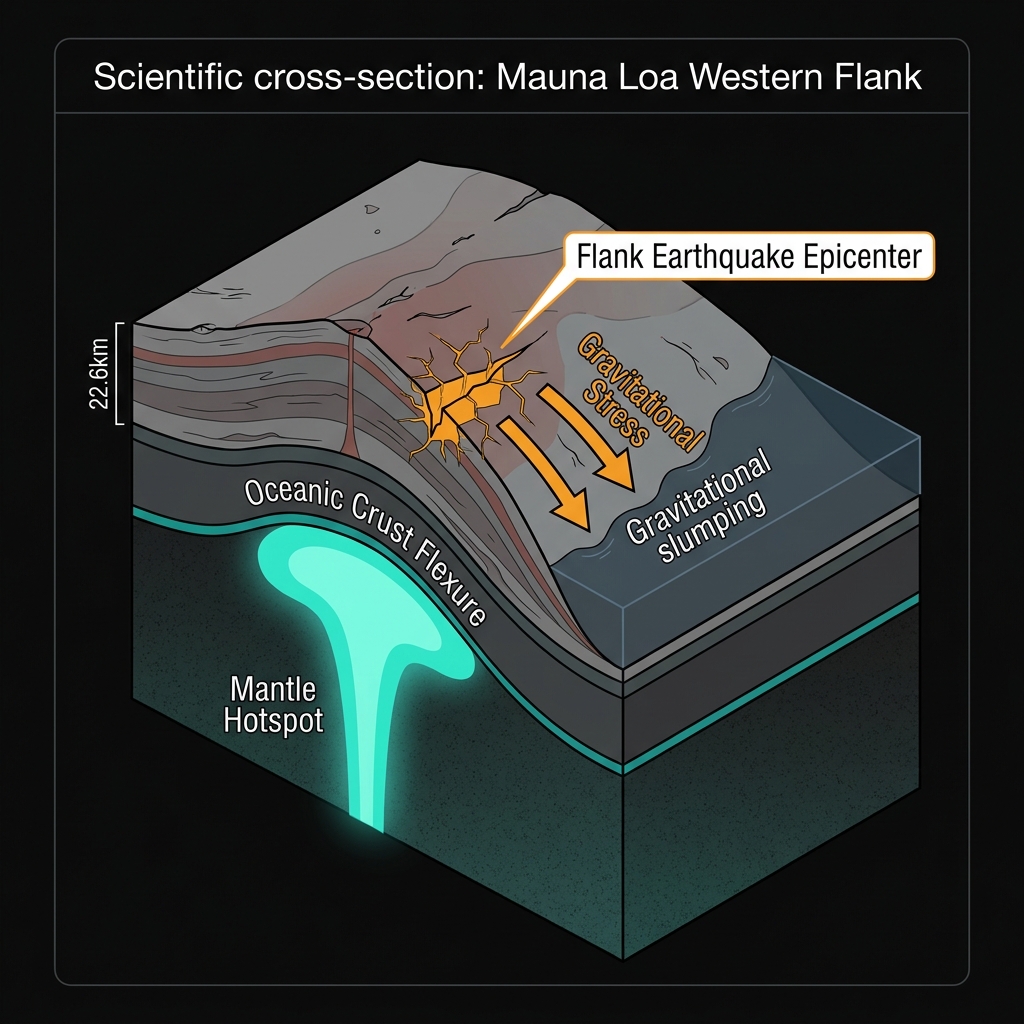
Hawaii’s reputation for volcanic spectacle often overshadows its seismic personality, yet the two are inseparable. The Big Island sits directly over a mantle hotspot, where magma upwelling builds massive shield volcanoes like Mauna Loa and Kilauea.
However, this earthquake did not originate from magma movement beneath an erupting crater. Instead, seismologists classify this as a flank earthquake—a structural adjustment occurring within the massive volcanic edifice itself. The islands’ immense weight causes the oceanic crust to flex and fracture, while gravity drives slow, catastrophic slumping of the volcano’s flanks toward the sea. These processes generate earthquakes exactly like today’s: shallow, crustal events capable of intense local shaking without volcanic eruption. The region has produced five magnitude 6+ earthquakes since 1989, including events in 2021 and 2006, establishing the Kona coast as one of Hawaii’s most seismically hazardous zones despite its distance from active volcanic vents.
How Dangerous Was the Shaking?
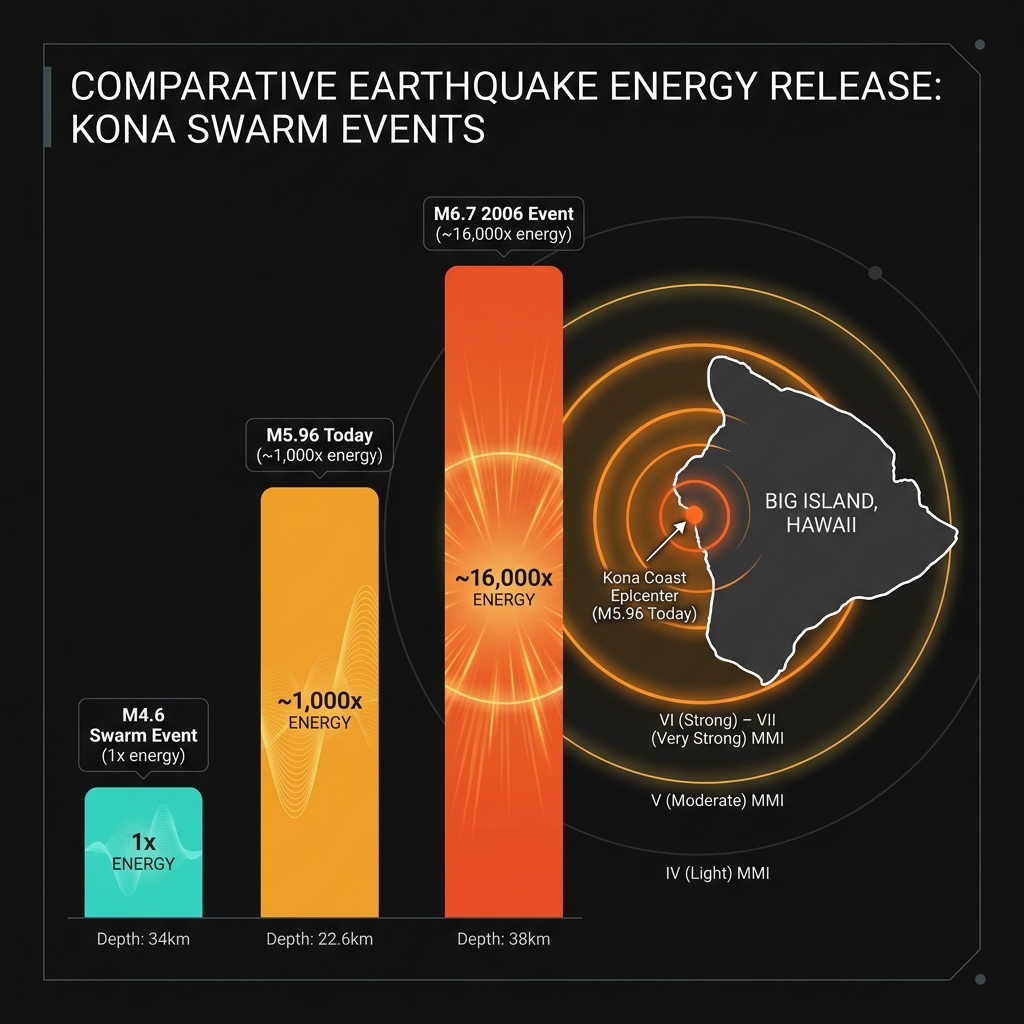
At 22.64 kilometers depth, this earthquake struck within the brittle crust—shallow enough that seismic energy reached the surface with minimal dissipation. Seismologists estimate the shaking likely reached Modified Mercalli Intensity VI to VII in the immediate epicentral region, meaning strong enough to crack plaster and dislodge heavy furniture, with potential for slight to moderate damage in poorly constructed buildings.
To understand the significance, consider the context of the current swarm. Before this M5.96 event, the sequence had produced 26 smaller earthquakes, topped by a magnitude 4.6 tremor earlier in the week. The following table illustrates how abruptly the energy release escalated:
| Event | Magnitude | Depth | Distance from Kona Coast | Relative Energy Release* |
|---|---|---|---|---|
| Today’s Mainshock | 5.96 | 22.6 km | 13 km | ~1,000x |
| Swarm Maximum (May 2026) | 4.6 | 34.0 km | 6 km | ~1x |
| 2006 Kona Earthquake | 6.7 | ~38 km | ~60 km | ~16,000x |
*Energy release compared to the M4.6 swarm event.
The 2006 M6.7 event—located roughly 60 kilometers to the northwest—caused an estimated $200 million in damage and left thousands without power. While today’s earthquake released roughly one-sixteenth the energy of that destructive predecessor, its closer proximity to population centers and shallower depth created a concentrated punch that residents described as a sharp, violent jolt rather than a rolling wave. This type of earthquake tells us the volcanic edifice is adjusting to immense gravitational stresses, distinct from the 2018 M6.9 earthquake associated with Kilauea’s lower East Rift Zone eruption, which occurred 89 kilometers away and represented magma-driven tectonics rather than flank instability.
What Should Residents Do?
With the region still reverberating from 27 earthquakes in one week, residents should treat this M5.96 event as a warning shot rather than a finale. Inspect foundations and masonry walls for fresh cracks, particularly in single-wall construction common to older Kona homes, and check propane tanks and gas lines for leaks using soapy water, as Hawaii’s ubiquitous LP gas systems are vulnerable to connection failures during sharp jolts. Secure water catchment systems and heavy furniture immediately, and avoid steep road cuts or cliffs for the next 48 hours, as aftershocks can dislodge loose rock on Hawaii’s fractured lava terrain. Keep emergency supplies for 14 days—not the standard 72 hours—as island supply chains remain fragile after significant seismic sequences.
What Happens Next?
Seismologists will monitor whether this M5.96 earthquake represents the climax of the swarm or merely a prelude to larger flank movement. Historical patterns suggest the Big Island could experience several magnitude 4+ aftershocks in the coming days, with a small probability of an even larger mainshock following. The USGS Hawaiian Volcano Observatory continues real-time analysis of ground deformation data, watching for any migration of seismicity toward the surface that might indicate volcanic reactivation. For now, the geological machinery beneath Kona continues its slow, grinding adjustment—a reminder that in Hawaii, the ground beneath your feet is never truly still.
Frequently Asked Questions
How strong was this earthquake compared to recent Hawaii quakes?
This magnitude 5.96 event released approximately 1,000 times more energy than the magnitude 4.6 that preceded it in the current swarm, and roughly one-sixteenth the energy of the destructive M6.7 Kona earthquake of 2006. While not catastrophic, its shallow depth and proximity to populated areas created localized shaking strong enough to cause minor structural damage.
Is there a tsunami risk from this earthquake?
No tsunami warning was issued for this event, and historical data suggests flank earthquakes of this magnitude and depth rarely generate significant ocean displacement. However, residents should remain aware that larger flank collapses—while extremely rare—remain a theoretical tsunami source for the Hawaiian Islands, making immediate coastal evacuation advisable if the ground shakes strongly for more than a minute.
Why is the Kona coast experiencing so many earthquakes right now?
The 27-event swarm reflects ongoing gravitational settling of Mauna Loa’s massive western flank, a process that has generated dozens of earthquakes in the Kona region historically. Unlike the volcanic earthquakes associated with magma movement beneath Kilauea, these events represent the structural groaning of the island’s own weight as it settles toward the ocean floor, a process that will continue for millennia as the Big Island grows.
Track this event live on the map!
Download GeoShake and get instant earthquake alerts.
Download GeoShake