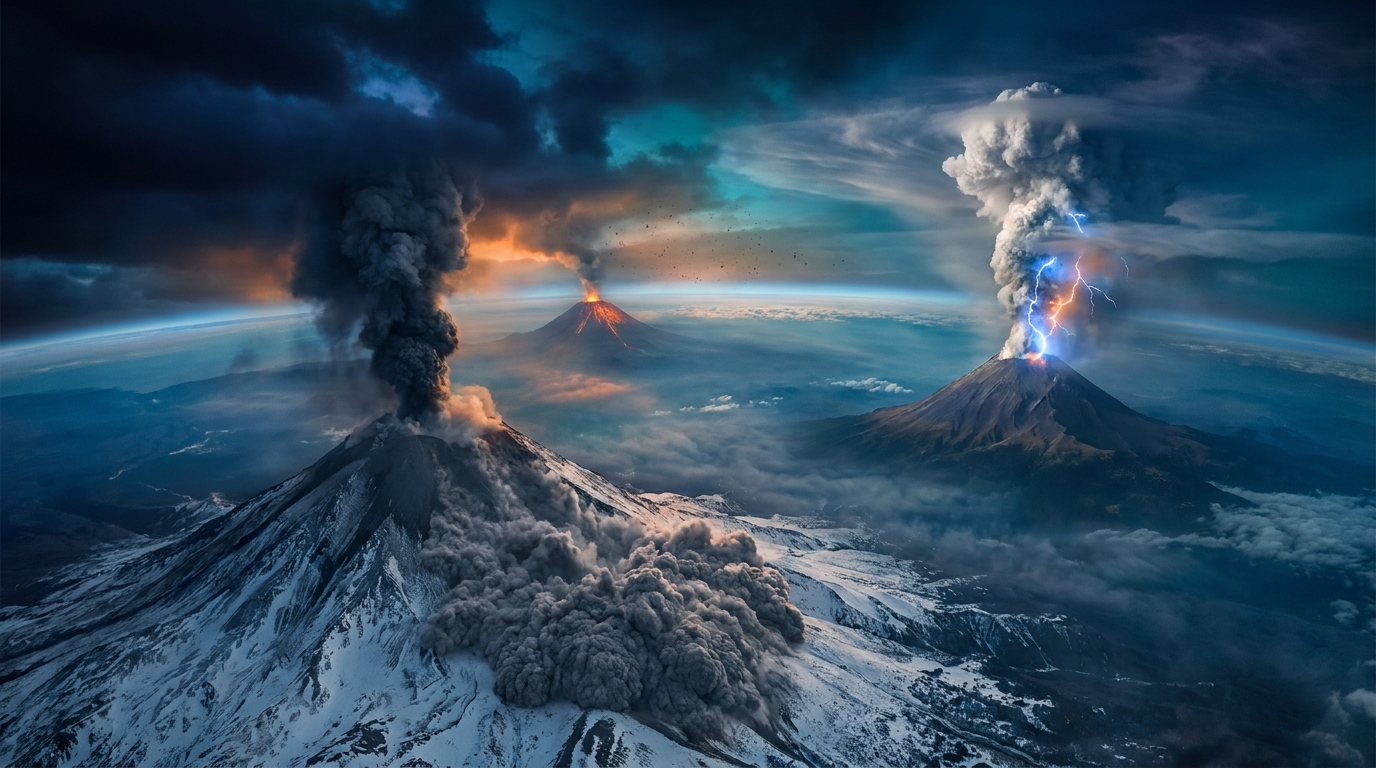
Twenty-five volcanic events were recorded across the globe in the last 24 hours according to the Smithsonian Global Volcanism Program, with significant eruptive activity reported at Bezymianny in Russia’s Kamchatka Peninsula and high-altitude ash advisories issued for major stratovolcanoes in Mexico and Indonesia. Volcanic ash clouds reached flight levels exceeding 6,000 meters, prompting urgent notifications to aviation authorities along trans-Pacific routes.
Which Volcanoes Showed Significant Activity Today?
Bezymianny (Kamchatka, Russia) entered a new eruptive phase on May 25, with the Kamchatka Volcanic Eruption Response Team (KVERT) confirming explosive activity at the summit dome. The volcano, one of Kamchatka’s most active and dangerous systems, produced ash emissions that were dispersed by prevailing winds. Bezymianny is renowned for its 1956 directed blast, which destroyed the summit and formed a horseshoe-shaped crater now occupied by a growing lava dome.
Popocatépetl (Mexico) generated a substantial ash advisory at 15:30 UTC on May 25, with the Volcanic Ash Advisory Center (VAAC) Washington reporting ash clouds reaching 6,100 meters (20,000 feet) above sea level. The Mexican stratovolcano, located just 70 kilometers southeast of Mexico City, continues its prolonged period of unrest characterized by frequent explosive events and ash fall affecting surrounding communities in Puebla and Morelos.
Semeru (East Java, Indonesia) produced an ash advisory at 00:15 UTC on May 26, with plume heights reaching 4,600 meters (15,090 feet) according to the Darwin VAAC. The volcano maintains nearly continuous Strombolian activity from its Jonggring-Seloko crater, regularly depositing ash on nearby agricultural areas while generating pyroclastic flows down the southern flank.
Central Bismarck Sea (Papua New Guinea) also triggered an ash advisory at 22:15 UTC on May 25, with maritime observations detecting ash clouds at 3,000 meters (9,800 feet). This submarine volcanic system in the Bismarck Sea has shown intermittent unrest, with surface discoloration and steam plumes indicating ongoing magmatic-hydrothermal activity beneath the waves.
How Are Ash Plumes Affecting Aviation Routes?
Volcanic ash clouds pose catastrophic risks to jet aircraft engines, making the elevated activity at Popocatépetl and Semeru particularly concerning for aviation safety. The 6,100-meter ash column from Popocatépetl penetrates the lower stratosphere, intersecting with busy commercial flight corridors connecting North America to Central and South America. Pilots are advised to exercise extreme caution within 100 nautical miles of the volcano until ash dissipation is confirmed.
Similarly, Semeru’s 4,600-meter plume affects domestic Indonesian routes and international flights traversing the Java Sea. The Darwin VAAC has issued trajectory forecasts showing ash dispersal toward the southwest, potentially impacting airports in Malang and Surabaya if wind patterns shift. The Central Bismarck Sea activity presents additional hazards for trans-Pacific routes connecting Asia to Australia and the Americas, though the lower altitude of 3,000 meters primarily affects regional aviation and maritime traffic.
What Is the Current Status of Other Active Volcanoes?
Beyond the highlighted advisories, numerous volcanoes across the Pacific Ring of Fire and other zones maintained elevated activity levels. Fuego (Guatemala) continued its characteristic Strombolian explosions and lava flow generation down the Ceniza and Las Lajas drainages. Reventador (Ecuador) produced intermittent explosions with ash plumes and incandescent blocks rolling down its flanks. Ibu (Halmahera, Indonesia) maintained its persistent eruption with lava dome growth and frequent ash emissions.
In the Philippines, Canlaon and Mayon remained under Alert Level 2 status, indicating increased unrest and potential for hazardous eruptions. Shiveluch, Bezymianny’s neighbor in Kamchatka, continued extruding viscous lava onto its dome complex. Dukono (Halmahera) and Puracé (Colombia) generated routine ash emissions, while Sangay (Ecuador) produced explosive activity affecting the Amazonian foothills.
| Volcano | Location | Event Type | Alert Level |
|---|---|---|---|
| Bezymianny | Kamchatka, Russia | Eruption | Not Reported |
| Popocatépetl | Mexico | Ash Advisory (6,100m) | Not Reported |
| Semeru | Indonesia | Ash Advisory (4,600m) | Not Reported |
| Central Bismarck Sea | Papua New Guinea | Ash Advisory (3,000m) | Not Reported |
| Fuego | Guatemala | Strombolian Eruption | Not Reported |
| Reventador | Ecuador | Explosive Activity | Not Reported |
| Ibu | Indonesia | Dome Eruption | Not Reported |
| Puracé | Colombia | Ash Emissions | Not Reported |
| Sangay | Ecuador | Explosions | Not Reported |
| Canlaon | Philippines | Volcanic Unrest | Not Reported |
| Mayon | Philippines | Lava Effusion | Not Reported |
| Dukono | Indonesia | Continuous Eruption | Not Reported |
| Shiveluch | Kamchatka, Russia | Dome Growth | Not Reported |
Data compiled from Smithsonian Global Volcanism Program reports and regional volcanic ash advisory centers. Alert levels reflect latest available monitoring data from local agencies.
Frequently Asked Questions
Is it safe to fly near these erupting volcanoes?
No, aircraft should avoid volcanic ash clouds entirely regardless of concentration. Volcanic ash melts in jet engines, causing compressor stalls and engine failure, while abrasive particles can damage windshields and airframe components. Pilots must rely on VAAC advisories and maintain minimum distances of 50-100 nautical miles from identified ash plumes until meteorological dispersion is confirmed.
How does the Smithsonian Global Volcanism Program track these events?
The Smithsonian GVP compiles data from a global network of local geological surveys, volcano observatories, satellite monitoring systems (including MODIS and VIIRS), and pilot reports to document eruptive activity. This information is synthesized into the Weekly Volcanic Activity Report, providing the scientific community and emergency managers with verified, authoritative accounts of global volcanic phenomena.
What precautions should communities near active volcanoes take today?
Residents within 10 kilometers of Popocatépetl, Semeru, or Bezymianny should prepare emergency evacuation kits and monitor official communications from CENAPRED, PVMBG, or KVERT respectively. Volcanic ash fall can contaminate water supplies and cause respiratory issues; vulnerable populations should remain indoors with windows sealed during ashfall events. Motorists should avoid driving during heavy ash accumulation to prevent engine damage and roadway accidents.
Track this event live on the map!
Download GeoShake and get instant earthquake alerts.
Download GeoShake