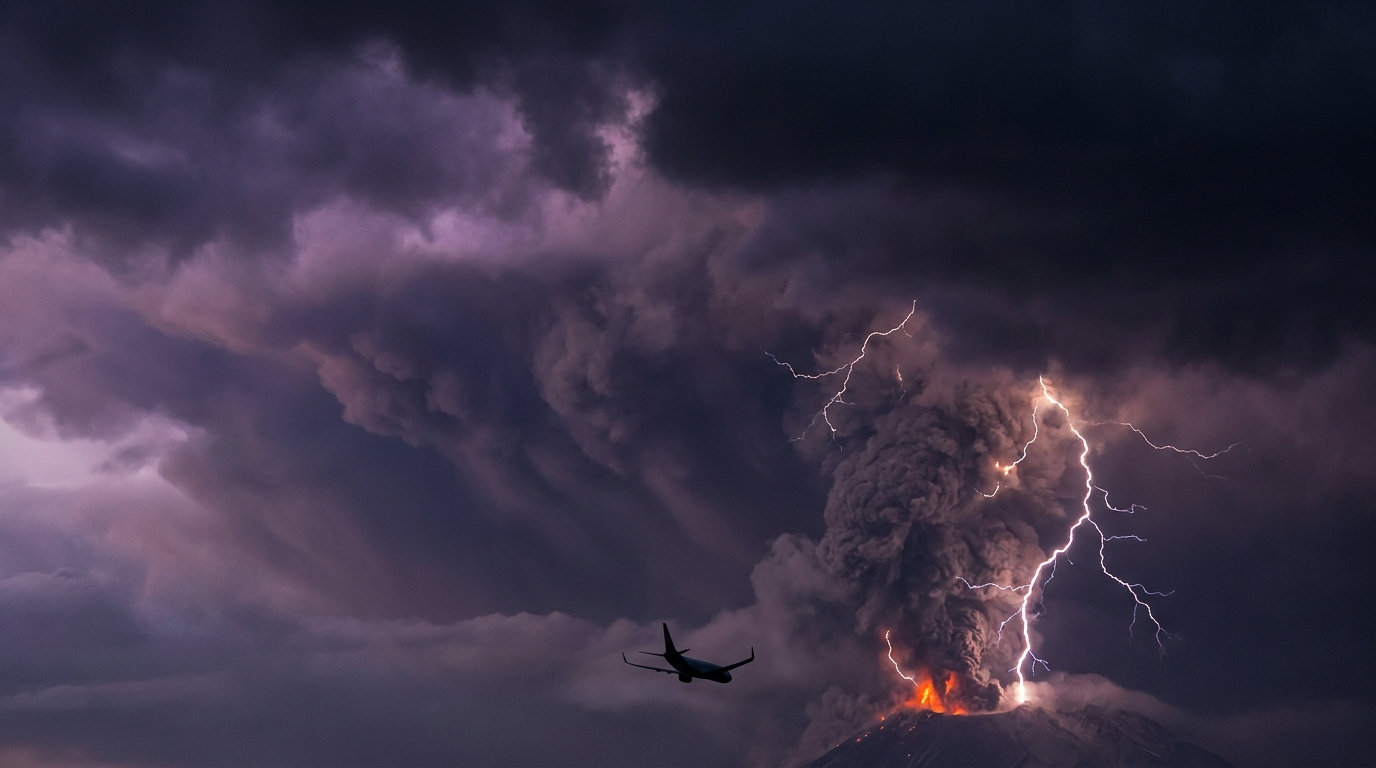
Volcanic unrest intensified across the Pacific Ring of Fire during the past 24 hours, with monitoring networks detecting 28 distinct eruptive events worldwide according to the Smithsonian Global Volcanism Program. The Kamchatka Peninsula’s Shiveluch volcano produced the most significant aviation hazard, ejecting ash to 8,800 meters altitude, while Peru’s Sabancaya generated a 7,000-meter plume. Multiple aviation color codes were elevated as agencies issued advisories for high-altitude ash clouds traversing busy flight corridors.
Which Volcanoes Produced the Highest Ash Columns Today?
Shiveluch, located on Russia’s Kamchatka Peninsula, dominated the aviation threat landscape with an ash advisory issued after explosive activity sent volcanic material to 8,800 meters (28,900 feet) above sea level according to the Tokyo Volcanic Ash Advisory Center (VAAC). This stratovolcano, known for its ongoing lava dome growth, frequently produces partial dome collapses that generate pyroclastic flows and significant ash clouds. The 8,800-meter altitude places this eruption firmly within commercial flight levels, specifically affecting FL290 and nearby corridors used by transpacific routes.
Sabancaya volcano in Peru’s Andes Mountains generated the second-highest ash column of the reporting period, reaching 7,000 meters (23,000 feet) according to the Buenos Aires VAAC. This persistent activity continues the volcano’s years-long eruptive sequence that began in 2016, characterized by vulcanian explosions and near-continuous ash emissions. The 7,000-meter plume affects regional aviation operations near Arequipa, though the aviation color code was listed as “NOT GIVEN” in initial advisories, suggesting ongoing assessment by local monitoring agencies.
What Activity Is Occurring at Indonesia’s Volcanoes?
Semeru volcano on East Java produced an ash advisory after explosive activity propelled volcanic material to 4,600 meters (15,100 feet) altitude according to monitoring data from the Indonesian Center for Volcanology and Geological Hazard Mitigation (CVGHM). The volcano’s active Jonggring Seloko crater continues to build a lava dome, with periodic collapse events generating pyroclastic flows down the Kobokan drainage. This 4,600-meter ash height affects lower flight levels around FL150, primarily impacting domestic Indonesian routes and local airports.
Ibu volcano on Halmahera and Lewotobi volcano on Flores also maintained active status during the reporting period, with thermal anomalies detected by satellite-based monitoring systems. Lewotobi continues to show elevated unrest following recent major explosive episodes, while Ibu persists with its characteristic strombolian activity and occasional ash venting. These Indonesian volcanoes represent the western Pacific’s contribution to the day’s 28 total global events.
Are There Risks in the Andes and Central America?
Reventador volcano in Ecuador’s Napo Province generated an ash advisory with plume heights reaching 4,600 meters (15,100 feet) according to the Washington VAAC. This remote stratovolcano, one of Ecuador’s most active, frequently produces explosions from its summit crater that send ash westward toward the Amazon basin. The 4,600-meter column coincidentally matches Semeru’s altitude, creating parallel aviation concerns on opposite sides of the Pacific.
Fuego volcano in Guatemala maintained its persistent strombolian activity, characterized by incandescent material ejected several hundred meters above the crater and active lava flows descending the volcano’s flanks. Sangay volcano in Ecuador and Puracé volcano in Colombia also showed elevated thermal signals and fumarolic activity, contributing to the Andean segment of the Ring of Fire’s elevated volcanic output.
How Is the Kamchatka Peninsula Contributing to Global Activity?
Beyond Shiveluch’s significant ash emission, Klyuchevskoy volcano on Kamchatka continued its ongoing strombolian activity with occasional ash plumes reported by the Kamchatka Volcanic Eruption Response Team (KVERT). This younger stratovolcano, Eurasia’s highest active volcano, typically produces cinder cone activity within its summit crater and sporadic lava flows down its steep slopes. The simultaneous activity at Shiveluch and Klyuchevskoy represents a period of heightened magmatic output for the Pacific’s northwestern edge.
What Does Today’s Activity Mean for Aviation Safety?
The four major ash advisories issued within 24 hours create complex routing challenges for aviation authorities managing transpacific and South American flight corridors. Ash clouds at 8,800 meters require diversion around FL290 for extended periods, while the 7,000-meter Sabancaya plume affects lower cruising altitudes common for regional jets. Volcanic ash particles can melt within jet engines and cause catastrophic failure, making these advisories critical for flight planning even when ash is not visible to pilots.
Local monitoring agencies including the USGS, CVGHM, and Russia’s KVERT continue to coordinate with VAACs to track dispersion models. The ash from Shiveluch typically drifts eastward toward Alaska, while Sabancaya emissions generally track southeast across Bolivia and into the Amazon.
Active Volcanoes Summary Table
| Volcano | Location | Event Type | Alert Level |
|---|---|---|---|
| Shiveluch | Russia (Kamchatka) | Ash Advisory (8,800m) | Not Specified |
| Sabancaya | Peru (Andes) | Ash Advisory (7,000m) | Not Specified |
| Reventador | Ecuador (Napo) | Ash Advisory (4,600m) | Not Specified |
| Semeru | Indonesia (East Java) | Ash Advisory (4,600m) | Not Specified |
| Fuego | Guatemala | Strombolian/Effusive | Not Specified |
| Klyuchevskoy | Russia (Kamchatka) | Strombolian | Not Specified |
| Ibu | Indonesia (Halmahera) | Thermal Anomaly | Not Specified |
| Lewotobi | Indonesia (Flores) | Explosive Eruption | Not Specified |
| Sangay | Ecuador (Morona-Santiago) | Ash Emissions | Not Specified |
| Mayon | Philippines (Albay) | Dome Growth | Not Specified |
| Canlaon | Philippines (Negros) | Volcanic Unrest | Not Specified |
| Aoba | Vanuatu | Gas/Ash Emissions | Not Specified |
| Puracé | Colombia (Cauca) | Fumarolic Activity | Not Specified |
| Central Bismarck Sea | Papua New Guinea | Submarine Activity | Not Specified |
Frequently Asked Questions
What does an ash advisory mean for aircraft?
An ash advisory indicates that volcanic ash has been detected in the atmosphere at altitudes that could affect aircraft operations. Pilots must avoid these areas because volcanic ash can severely damage jet engines, abrade cockpit windows, and clog critical flight instruments, potentially leading to complete engine failure and loss of control even when the ash cloud is not visible to the naked eye.
How high is dangerous for volcanic ash?
Volcanic ash becomes dangerous for aviation at any altitude where aircraft operate, but plumes exceeding 6,000 meters (20,000 feet) pose the greatest risk to commercial air traffic because they intersect with typical cruising altitudes between FL250 and FL400. Today’s Shiveluch eruption reaching 8,800 meters affects high-altitude long-haul routes, while the 4,600-meter plumes from Semeru and Reventador primarily threaten regional aircraft and approach phases.
Which volcano poses the greatest risk today?
Shiveluch volcano currently presents the highest aviation risk due to its 8,800-meter ash column that penetrates the upper flight levels used by transpacific commercial routes. The volcano’s history of sudden dome collapses and its position beneath busy airways between North America and Asia combine to create significant potential for airspace disruption, requiring continuous monitoring by the Tokyo VAAC and airline dispatchers.
Track this event live on the map!
Download GeoShake and get instant earthquake alerts.
Download GeoShake