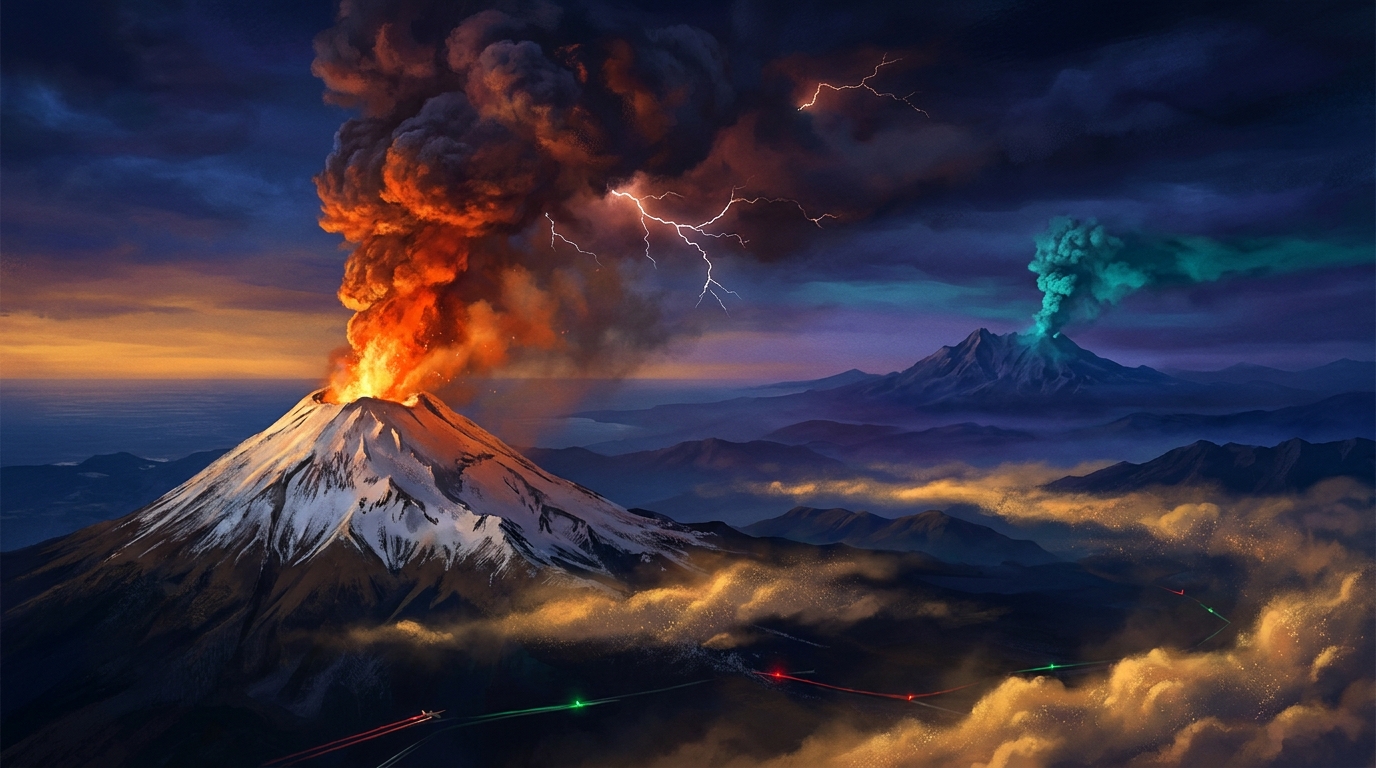
Volcanic activity remained elevated across the Pacific Ring of Fire and beyond during the past 24 hours, with monitoring agencies documenting 27 distinct volcanic events globally. According to the Smithsonian Global Volcanism Program, notable ash advisories were issued for two major stratovolcanoes—Mexico’s Popocatépetl and Russia’s Shiveluch—both sending ash plumes to approximately 6,700 meters above sea level. Additional unrest was detected at Guatemala’s Fuego and Colombia’s Puracé, while persistent activity continued at Indonesia’s Semeru, Ecuador’s Reventador, and Japan’s Sakurajima.
Which Volcanoes Generated Ash Advisories Today?
Mexico’s Popocatépetl stratovolcano exhibited significant explosive activity on May 18, generating an ash column that reached 6,700 meters above sea level according to the Smithsonian Global Volcanism Program. The eruption, which occurred at approximately 19:00 UTC, sent volcanic ash drifting northeastward, prompting aviation advisories for the region surrounding Mexico City. At 5,426 meters elevation, this represents a plume rise of roughly 1,300 meters above the summit crater, indicating moderate explosive energy with potential for local ashfall in Puebla and Veracruz states.
On the opposite side of the Pacific, Russia’s Shiveluch volcano on the Kamchatka Peninsula produced a comparable ash column reaching 6,700 meters at 06:00 UTC on May 18. This lava dome complex, one of Kamchatka’s largest and most active volcanoes, continues its decades-long eruptive cycle characterized by dome growth and periodic Vulcanian explosions. The ash cloud posed immediate concerns for trans-Pacific aviation routes, with the Tokyo and Anchorage Volcanic Ash Advisory Centers monitoring dispersion patterns eastward over the Bering Sea.
In Central America, Guatemala’s Fuego volcano maintained persistent strombolian activity with continuous ash emissions reported at 02:30 UTC on May 19 according to local monitoring agencies. While specific column heights were not quantified in initial reports, the volcano—which sits just 40 kilometers from Guatemala City—typically produces ash plumes ranging from 4,500 to 5,500 meters during active phases. Simultaneously, Colombia’s Puracé volcano in the Cauca department registered ash emission events at 02:15 UTC, adding to ongoing volcanic unrest along the northern Andean Volcanic Belt.
What Technical Parameters Characterize These Events?
The ash advisories issued for Popocatépetl and Shiveluch both specified identical maximum column heights of 6,700 meters, placing these eruptions in the lower range of sub-Plinian to Vulcanian explosive types. Such column heights typically correspond to Volcanic Explosivity Index (VEI) 2-3 events, capable of depositing ash tens of kilometers downwind while injecting material into the lower troposphere. Seismic data from both volcanoes indicated long-period earthquake sequences preceding the explosions, consistent with gas slug ascent and pressure release mechanisms.
Fuego’s activity, while less quantified in this reporting period, historically produces basaltic-andesite compositions with ash-rich explosions occurring at intervals of 15-30 minutes during active phases. The volcano’s steep cone structure facilitates rapid pyroclastic flow generation when dome collapse occurs, though current reports indicate primarily ash venting without major flow generation. Puracé, a complex stratovolcano reaching 4,646 meters elevation, exhibited sulfur dioxide emissions detectable by satellite sensors, indicating continued magma degassing at depth with ash content rich in crystalline silica.
How Dangerous Are the Ash Emissions for Aviation Operations?
Volcanic ash clouds extending to 6,700 meters present critical hazards for commercial aviation, intersecting typical cruising altitudes for regional and short-haul flights. According to the International Civil Aviation Organization (ICAO) standards, ash concentrations above 4,000 meters require immediate airspace restrictions, as volcanic glass particles can melt within jet turbine engines and cause compressor stall or total engine failure. Both the Mexico City and Anchorage VAACs issued graphical ash dispersion forecasts extending 24-48 hours beyond the initial eruption times, with avoidance zones established within 100 nautical miles of the volcanic sources.
The silica content of Popocatépetl’s ash—typically ranging from 55-60% SiO2—creates particularly abrasive conditions for aircraft windshields and airframes. Pilots encountering these conditions face reduced visibility and potential electrical system failures due to static electricity generated by ash particle friction. For Shiveluch, the high latitude location means ash can encounter polar jet stream winds exceeding 200 kilometers per hour, potentially accelerating dispersion rates and extending the hazard area toward North American air corridors within 12-24 hours.
What Other Volcanoes Show Ongoing Activity?
Beyond the headline ash advisories, fifteen additional volcanoes maintained active status during the reporting period according to the Smithsonian Global Volcanism Program. Indonesia’s archipelago remained particularly active, with Semeru, Dukono, and Ibu all recording continuous explosive or effusive behavior. Japan’s Sakurajima produced minor eruptive bursts typical of its persistent activity, while Ecuador’s Reventador generated strombolian explosions audible at monitoring stations 30 kilometers distant.
The Philippines monitored two active systems: Mayon, which continues gentle lava effusion from its summit crater generating rockfall events, and Canlaon, showing heightened seismic unrest without surface eruption. In South America, Chile’s Villarrica maintained its lava lake activity with minor surface explosions, while Peru’s Sabancaya produced gas-and-ash columns reaching 3,500 meters above its 5,967-meter summit. Russia’s Bezymianny showed continued lava dome growth with incandescence visible in nighttime satellite imagery.
Current Volcanic Activity Summary
| Volcano | Location | Event Type | Alert Level |
|---|---|---|---|
| Popocatépetl | Mexico | Ash Advisory | Yellow (Amarillo Fase 2) |
| Shiveluch | Russia | Ash Advisory | Orange |
| Fuego | Guatemala | Ash Emissions | Orange |
| Puracé | Colombia | Ash Advisory | Yellow (III) |
| Sakurajima | Japan | Minor Eruption | Level 3 (Alert) |
| Bezymianny | Russia | Lava Dome Growth | Yellow |
| Dukono | Indonesia | Continuous Ash | Orange |
| Mayon | Philippines | Lava Effusion | Alert Level 2 |
| Semeru | Indonesia | Explosive Eruption | Level III (Siaga) |
| Reventador | Ecuador | Strombolian | Orange |
| Ibu | Indonesia | Eruption | Orange |
| Villarrica | Chile | Minor Activity | Yellow (Amarilla) |
| Canlaon | Philippines | Seismic Unrest | Alert Level 1 |
| Sabancaya | Peru | Explosive | Orange |
Alert levels based on classifications from local monitoring agencies reported by the Smithsonian Global Volcanism Program and USGS.
Frequently Asked Questions
What immediate health risks do these ash emissions pose to local communities?
Popocatépetl’s ashfall affects approximately 25 million people living within a 100-kilometer radius of the volcano, with respiratory irritation being the primary health concern for vulnerable populations including children and the elderly. Residents should wear N95 masks when outdoors and avoid using contact lenses during ashfall events, as volcanic glass particles can cause corneal abrasions; water supplies may also become contaminated with fluoride and other volcanic chemicals that leach from fresh ash deposits.
Can volcanic ash from Kamchatka affect weather patterns in North America?
While the current ash plume from Shiveluch remains localized to the North Pacific, volcanic eruptions with column heights exceeding 10 kilometers can inject sulfur dioxide aerosols into the stratosphere, potentially causing regional cooling effects lasting 1-3 years. The 6,700-meter column observed today likely remains within the troposphere, where ash settles within days rather than weeks, minimizing long-term climatic impacts though potentially disrupting regional weather patterns temporarily.
How do volcanologists determine when an ash advisory is necessary?
Scientists combine seismic data indicating explosive eruptions with satellite observations of thermal anomalies and ground-based visual confirmation to trigger ash advisories when columns exceed safe aviation thresholds of 3,000-4,000 meters. The Smithsonian Global Volcanism Program coordinates with nine global Volcanic Ash Advisory Centers to issue warnings within 15 minutes of eruption detection, using numerical weather prediction models to forecast ash dispersion up to 48 hours in advance based on wind speed, direction, and particle size distributions.
Track this event live on the map!
Download GeoShake and get instant earthquake alerts.
Download GeoShake