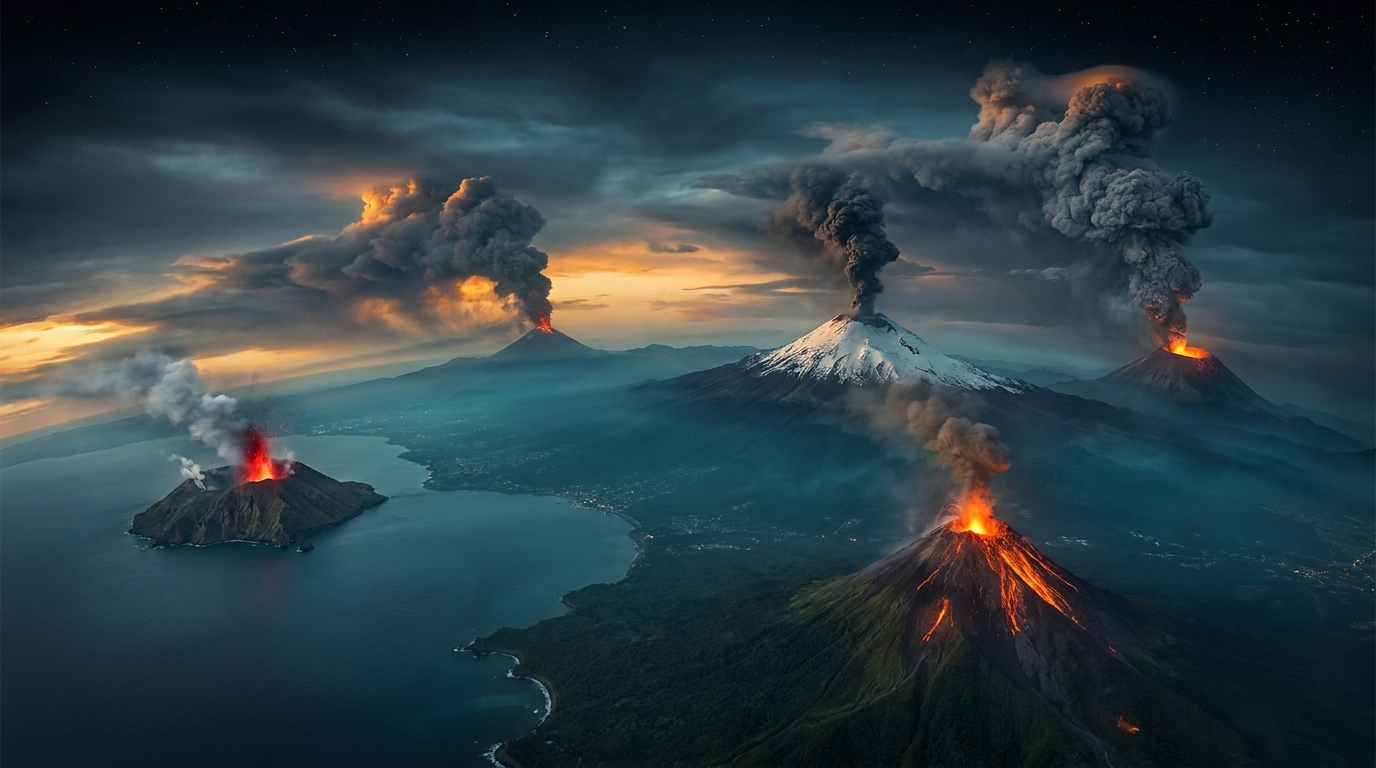
Global volcanic monitoring networks recorded 35 significant events across 16 active volcanoes during the past 24 hours, according to the Smithsonian Global Volcanism Program and regional volcanic ash advisory centers. Notable activity includes explosive eruptions at Fuego in Guatemala, Sangay in Ecuador, and Stromboli in Italy, alongside critical aviation ash advisories for Shiveluch in Russia and Popocatépetl in Mexico. These events underscore the continuous dynamic nature of subduction zone volcanism and intraplate thermal anomalies worldwide, requiring heightened vigilance from aviation authorities and local emergency management agencies.
Which Volcanoes Showed Significant Eruptive Activity Today?
Fuego Volcano, Guatemala, generated explosive eruptions beginning at 10:26 UTC on May 28, 2026, producing ash plumes and potential pyroclastic flows down its steep flanks. This stratovolcano, located approximately 40 kilometers southwest of Guatemala City, maintains one of the highest activity levels in Central America with near-constant degassing and frequent paroxysmal events. The current eruptive phase likely involves Strombolian-to-Vulcanian explosions generating ash columns reaching several kilometers above the crater, posing localized hazards to nearby communities through ashfall and ballistic projectiles.
Sangay Volcano, Ecuador, erupted at 22:26 UTC on May 28, 2026, continuing its persistent activity within the remote Amazon region of the Morona-Santiago Province. This steep-sided stratovolcano, standing at 5,230 meters elevation, frequently produces pyroclastic flows and lahars that threaten the watersheds of the Amazon basin. Sangay’s eruptions typically feature vulcanian explosions with ash plumes rising 5-10 kilometers above sea level, often dispersing toward the east and northeast according to wind patterns monitored by the Washington Volcanic Ash Advisory Center.
Stromboli Volcano, Italy, exhibited explosive activity at 21:00 UTC on May 28, 2026, maintaining its reputation as the “lighthouse of the Mediterranean” with characteristic Strombolian eruptions from multiple summit vents. Located on the northern coast of Sicily in the Tyrrhenian Sea, this volcano produces frequent mild explosions ejecting incandescent cinder, lapilli, and lava bombs above the crater terrace. While typically confined to the summit area, Stromboli’s activity occasionally generates stronger explosions capable of producing ash plumes affecting local maritime traffic and the small island community.
Where Are Aviation Ash Advisories Currently Active?
Shiveluch Volcano, Russia, issued a critical aviation ash advisory at 18:15 UTC on May 28, 2026, with volcanic ash detected at 8,200 meters (27,000 feet) above sea level. Located on the Kamchatka Peninsula in the Russian Far East, Shiveluch maintains an active lava dome that periodically collapses, generating explosive ash columns and pyroclastic flows that travel significant distances across the terrain. The Tokyo Volcanic Ash Advisory Center continues monitoring the ash cloud dispersion, which poses significant hazards to trans-Pacific flight routes between North America and Asia.
Popocatépetl Volcano, Mexico, generated an ash advisory at 02:00 UTC on May 29, 2026, with emissions reaching 5,800 meters (19,000 feet) altitude and drifting toward the east-northeast. This massive stratovolcano, situated approximately 70 kilometers southeast of Mexico City, represents one of the most hazardous volcanoes in North America due to its proximity to 20 million people in the Mexico City metropolitan area. The current ash emissions result from ongoing dome growth and intermittent explosions, prompting continuous monitoring by Mexico’s National Center for Disaster Prevention (CENAPRED) and the Washington VAAC.
What Is the Current Status of Other Monitored Volcanoes?
Mayon Volcano in the Philippines continues to show unrest with elevated seismicity and potential lava dome growth, maintaining Alert Level 2 restrictions around the permanent danger zone. Puracé Volcano in Colombia and Sabancaya in Peru both exhibit elevated degassing and seismic swarms indicative of magma movement at shallow depths. Indonesian volcanoes Semeru, Dukono, Ibu, and Lewotolo maintain frequent eruptive activity typical of the Pacific Ring of Fire, producing ash plumes and volcanic tremor recorded by the Pusat Vulkanologi dan Mitigasi Bencana Geologi (PVMBG).
Reventador and Santiaguito in Guatemala continue effusive-explosive activity, while Canlaon in the Philippines shows signs of increased seismicity requiring close observation. Aoba (Ambae) in Vanuatu maintains a low-level eruptive state with ongoing gas emissions affecting island communities. These persistent activity patterns reflect the diverse tectonic settings—from oceanic island arcs to continental subduction zones—that drive global volcanism.
Which Volcanoes Are Currently Under Alert?
| Volcano | Location | Event Type | Alert Level |
|---|---|---|---|
| Fuego | Guatemala | Explosive Eruption | Orange/Watch |
| Sangay | Ecuador | Ash Eruption | Orange/Watch |
| Stromboli | Italy | Strombolian Activity | Moderate |
| Shiveluch | Russia | Ash Advisory (8,200m) | Orange |
| Popocatépetl | Mexico | Ash Advisory (5,800m) | Yellow/Orange |
| Mayon | Philippines | Volcanic Unrest | Alert Level 2 |
| Puracé | Colombia | Seismic Swarm | Yellow |
| Aoba | Vanuatu | Gas Emissions | Level 2 |
| Sabancaya | Peru | Explosive Activity | Orange |
| Semeru | Indonesia | Ash Eruptions | Level II (Alert) |
| Reventador | Ecuador | Explosive-Effusive | Orange |
| Canlaon | Philippines | Seismic Uplift | Alert Level 1 |
| Dukono | Indonesia | Continuous Ash | Level II |
| Ibu | Indonesia | Lava Dome Growth | Level III (Standby) |
| Lewotolo | Indonesia | Strombolian | Level II |
| Santiaguito | Guatemala | Lava Dome Extrusion | Active/Orange |
Frequently Asked Questions
What Does an Aviation Ash Advisory Mean for Air Travel?
An aviation ash advisory indicates that volcanic ash has been detected at altitudes used by commercial aircraft, typically issued by one of nine global Volcanic Ash Advisory Centers (VAACs) when plumes exceed flight levels. Volcanic ash poses catastrophic risks to jet engines, including flameout from melted ash coating turbine blades and abrasion of windshields and airframes, requiring immediate rerouting of flight paths to avoid contamination zones. Pilots and dispatchers rely on these advisories to calculate alternative routes that maintain safety margins while minimizing fuel costs and delays.
How Do Scientists Determine Volcano Alert Levels?
Volcano observatories establish alert levels by integrating multiple monitoring datasets including seismic activity (earthquake frequency, magnitude, and depth), ground deformation measured by GPS and satellite interferometry, gas emissions detected by spectrometers, and visual observations of eruptive phenomena. Each volcano typically maintains a baseline activity level, and deviations trigger systematic escalation through color-coded or numbered alert systems that communicate hazard potential to aviation authorities and local populations. The specific thresholds vary by volcano based on its unique eruptive history, proximity to populations, and dominant hazard types.
Why Do Some Volcanoes Erupt Continuously While Others Remain Dormant for Centuries?
Continuously active volcanoes like Stromboli or Dukono feature open conduit systems that allow magma to rise and degassively erupt with minimal pressure buildup, preventing the catastrophic accumulation that characterizes dormant systems. Conversely, volcanoes with long repose periods often develop sealed plumbing systems where viscous magma crystallizes and traps gases, leading to explosive pressure releases when new magma finally ascends. The frequency of eruptions depends fundamentally on magma supply rates from the mantle, crustal thickness affecting magma storage, and the tectonic stress regime that either facilitates or inhibits magma ascent pathways.
Track this event live on the map!
Download GeoShake and get instant earthquake alerts.
Download GeoShake