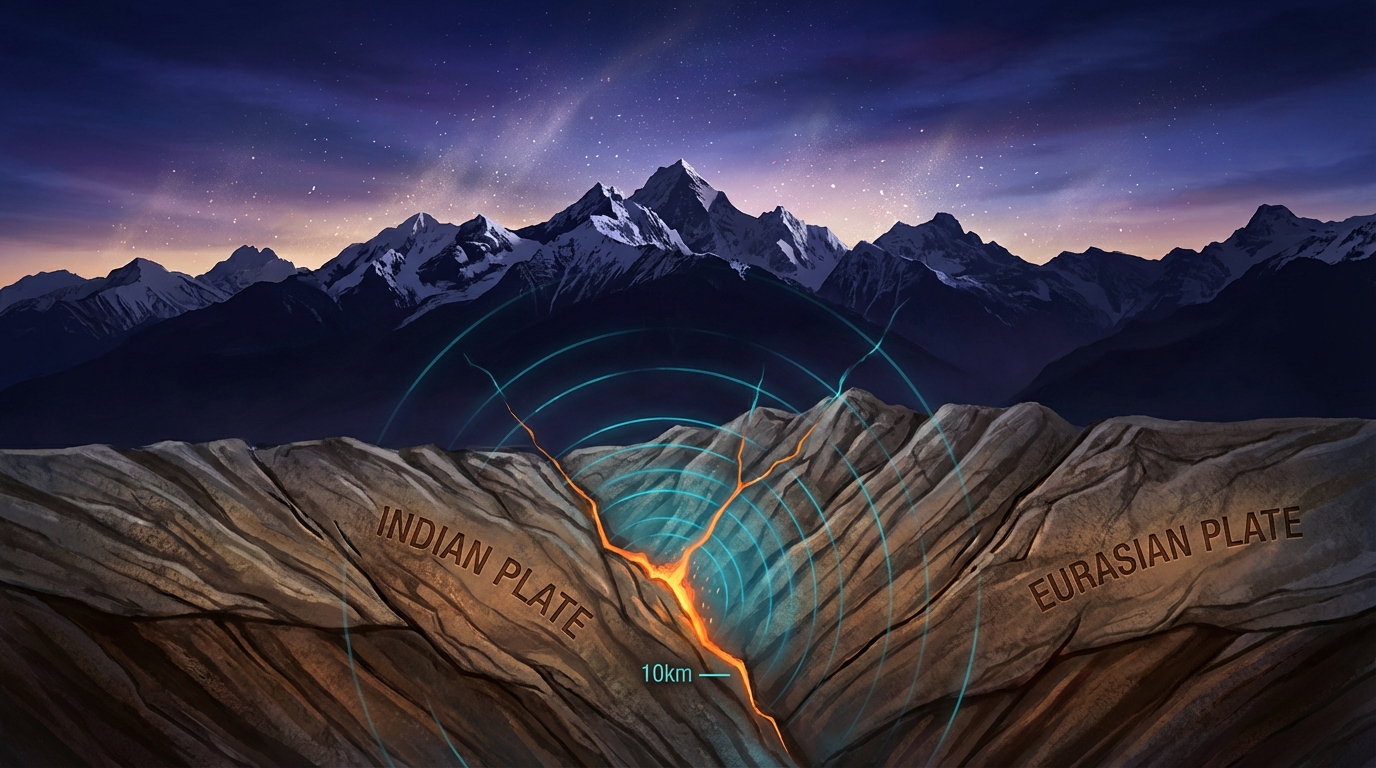
The ground shook at 4:40 a.m. local time with little warning, a sudden jolt radiating from just 10 kilometers below the surface—shallower than the height of Mount Everest stacked atop itself. The magnitude 5.0 tremor struck 42 kilometers north-northwest of Barishal, Pakistan, according to USGS data, rattling a region where the geological machinery of plate tectonics grinds with persistent intensity. For residents in this rugged terrain near the Afghanistan-Pakistan borderlands, the early morning rumble served as another reminder that they live atop one of Earth’s most active collision zones.
Why Is This Region So Seismically Active?
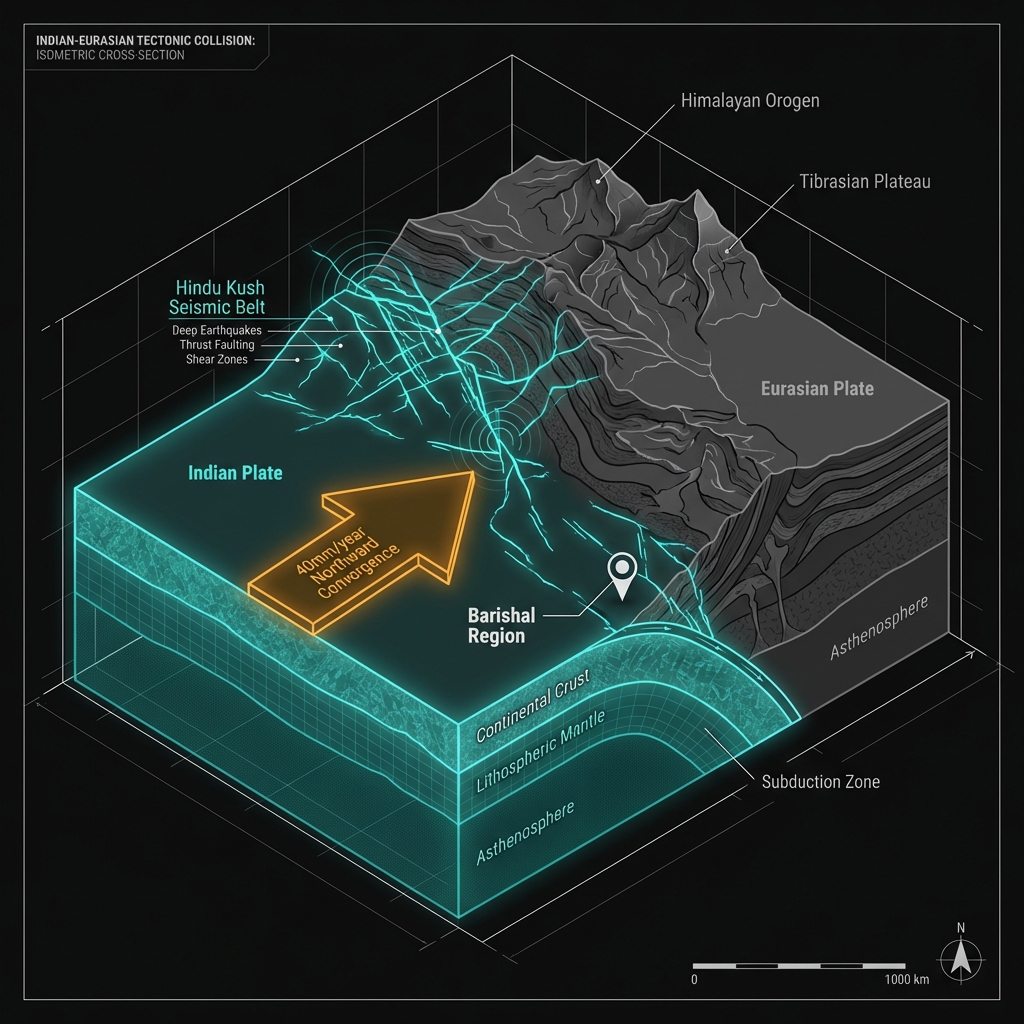
This corner of South Asia sits at the crucible of the ongoing collision between the Indian and Eurasian tectonic plates, a slow-motion crash that began roughly 50 million years ago and continues to push the Himalayas skyward today. When continental plates collide at convergent boundaries, the crust doesn’t simply sink; it crumples, thrusts, and fractures, creating a complex network of faults that store elastic energy like a coiled spring.
The Barishal area lies within the broader Hindu Kush and Himalayan seismic belt, where the Indian plate subducts—or slides beneath—the Eurasian plate at a rate of approximately 40 millimeters per year. This relentless convergence explains why the region has hosted numerous significant temblors, including a magnitude 6.9 event that struck western Tajikistan in 2023 approximately 190 kilometers from today’s epicenter, and multiple magnitude 6.3 earthquakes in Afghanistan and Pakistan during the 1990s and early 2000s. Seismologists classify this tectonic environment as intracontinental deformation, where the rigid Indian plate pushes beneath softer Eurasian crust, generating shallow faults in the upper 15 kilometers of the lithosphere.
What Does This Depth Mean for Shaking?
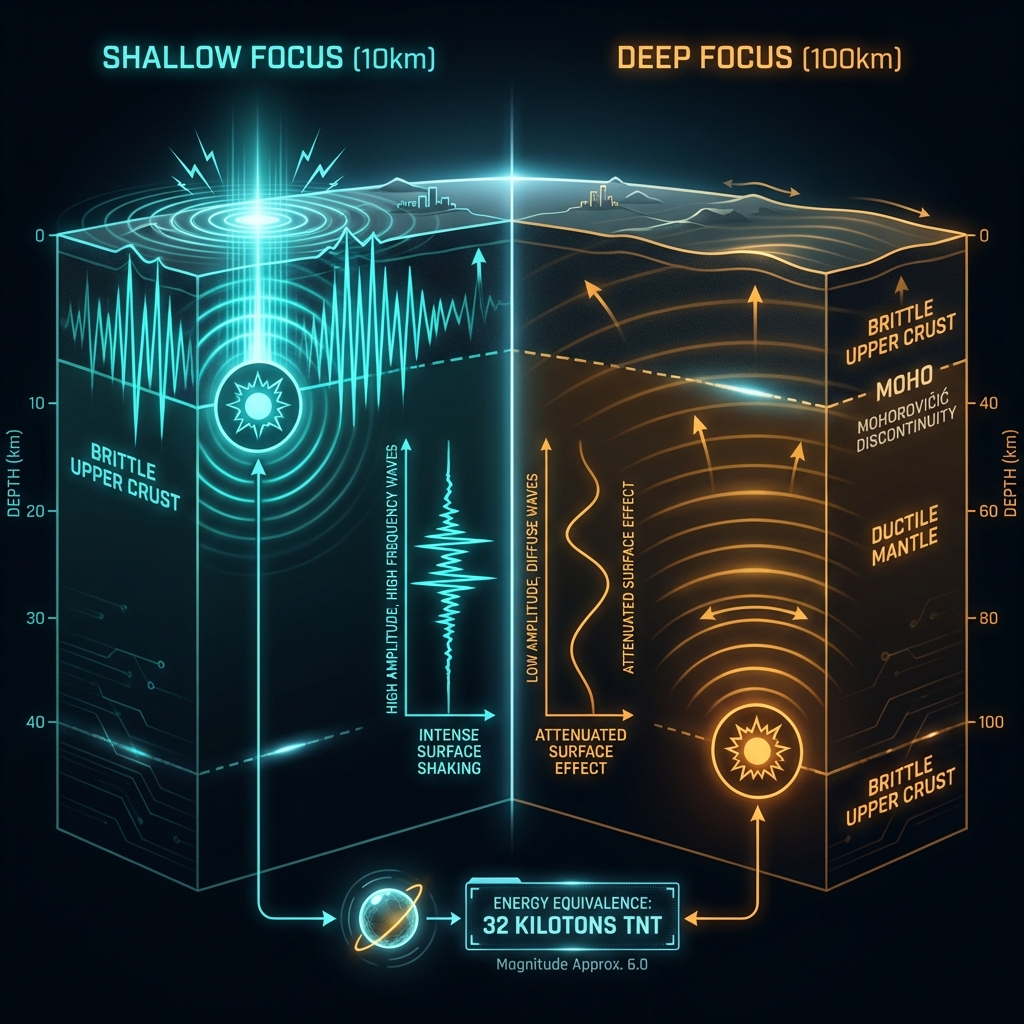
At 10 kilometers depth, seismologists classify this as a shallow-focus earthquake, meaning the rupture occurred within the brittle upper crust where seismic energy dissipates less before reaching the surface. The shallower the quake, the less the earth absorbs its vibrations, often resulting in more intense localized shaking than a deeper event of equivalent magnitude. To put this in perspective, a magnitude 5.0 release roughly equals the energy of 32,000 tons of TNT—comparable to the atomic bomb dropped on Hiroshima, though spread across a broad area rather than concentrated at a single point.
This event follows closely on the heels of another shallow tremor recorded just seven days prior. The proximity of these two events suggests localized stress release along a specific fault structure or potential foreshock-aftershock sequencing, though seismologists caution that identifying such relationships requires more data analysis.
| Feature | March 27, 2026 Event | March 20, 2026 Event |
|---|---|---|
| Magnitude | 5.0 mb | 5.3 mb |
| Depth | 10 km | 10 km |
| Distance from Barishal | 42 km NNW | 33 km NW |
| Energy Release | ~32 kilotons TNT equivalent | ~63 kilotons TNT equivalent |
The difference between a 10-kilometer and a 100-kilometer deep earthquake is stark: deep events send waves through the ductile mantle, which absorbs much of their high-frequency energy, resulting in a rolling motion felt over vast distances. Shallow quakes like this one transmit sharp, high-frequency vibrations directly to the surface, creating the jarring motion most damaging to buildings.
What Should We Watch For Now?
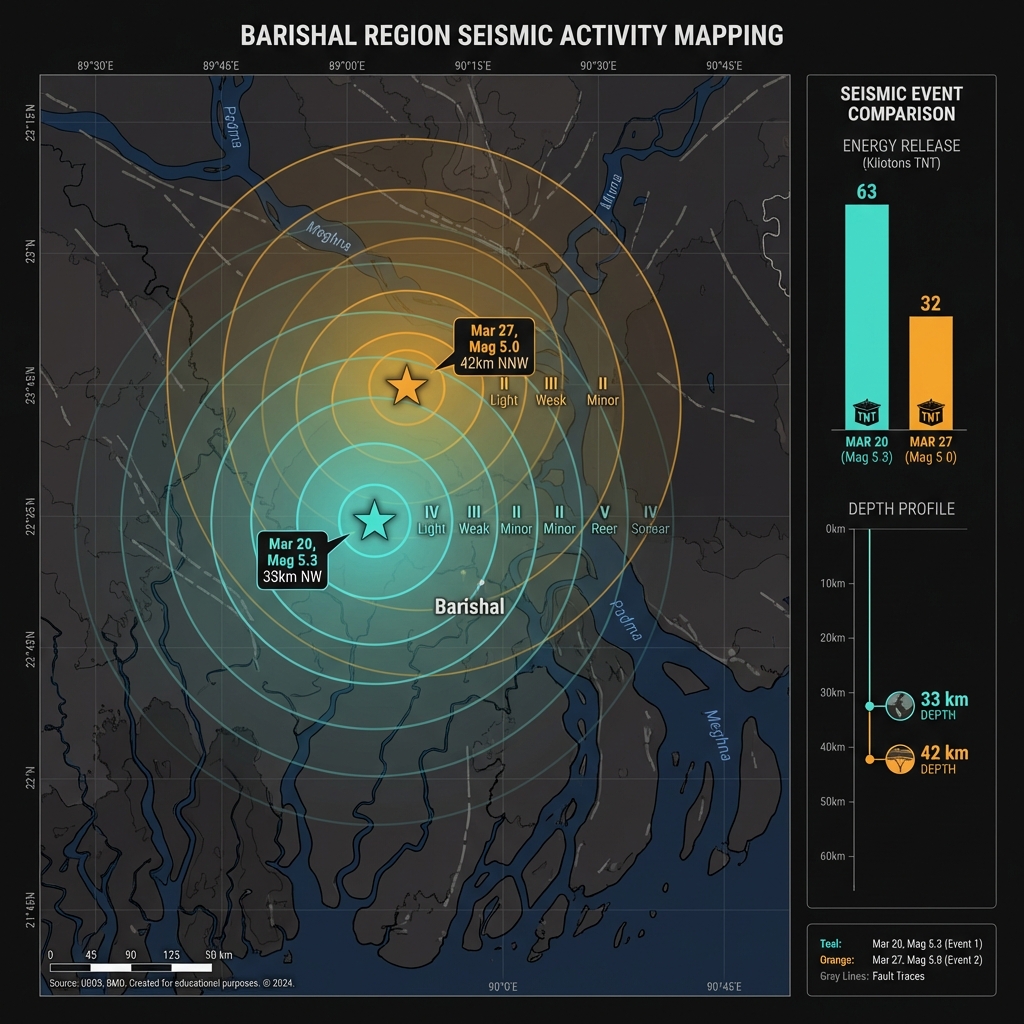
Given that this marks the second magnitude 5-plus event in the Barishal region within a week, seismologists will be monitoring closely for aftershocks or potentially larger mainshocks that could indicate a seismic swarm in progress. Historical records remind us that this broader region is capable of producing significantly stronger events; the 1990 magnitude 6.3 earthquake in eastern Afghanistan and the 2002 magnitude 6.3 temblor near Gilgit, Pakistan, both occurred within 140 kilometers of today’s epicenter. While no tsunami warning was issued for this inland event, communities should remain prepared for secondary shaking, as the geological stresses that produced these twin quakes may not have fully dissipated. GeoShake will continue tracking activity across this volatile boundary where the Indian plate persists in its ancient, unstoppable northward journey.
Frequently Asked Questions
How strong was this earthquake?
A magnitude 5.0 earthquake releases approximately 32,000 tons of TNT equivalent energy, classifying it as a moderate event capable of causing localized damage to poorly constructed buildings near the epicenter. At a shallow depth of 10 kilometers, the shaking would have felt significantly stronger than a deeper quake of the same magnitude, potentially waking sleepers and rattling dishes across the region.
Is there a tsunami risk?
No tsunami warning was issued for this event, as it occurred inland at significant distance from any coastline. Tsunamis typically require underwater displacement of the seafloor during submarine earthquakes, usually magnitude 7.0 or greater, or significant landslides into oceanic waters.
Why is this area so seismically active?
This region sits at the collision zone between the Indian and Eurasian tectonic plates, where the Indian plate subducts beneath Eurasia at roughly 40 millimeters per year. This convergence creates intense crustal deformation, frequent earthquakes, and the ongoing uplift of the Himalayan mountain range, making it one of Earth’s most seismically hazardous zones.
Track this event live on the map!
Download GeoShake and get instant earthquake alerts.
Download GeoShake