
The earth has been restless beneath Erzincan. On April 17, a magnitude 4.1 earthquake struck the eastern Turkish province, serving as the exclamation point on a week-long swarm of 86 tremors that has kept seismologists tracking a familiar fault line. According to USGS data, the shallow event rattled the village of Üzümlü at 12:40 UTC, coming to rest just nine kilometers from the epicenter of the devastating 1992 M6.7 quake that killed more than 600 people—a geographical echo that reminds residents how tightly history and geology intertwine in this valley.
Why Is This Region a Hotspot for Seismic Activity?
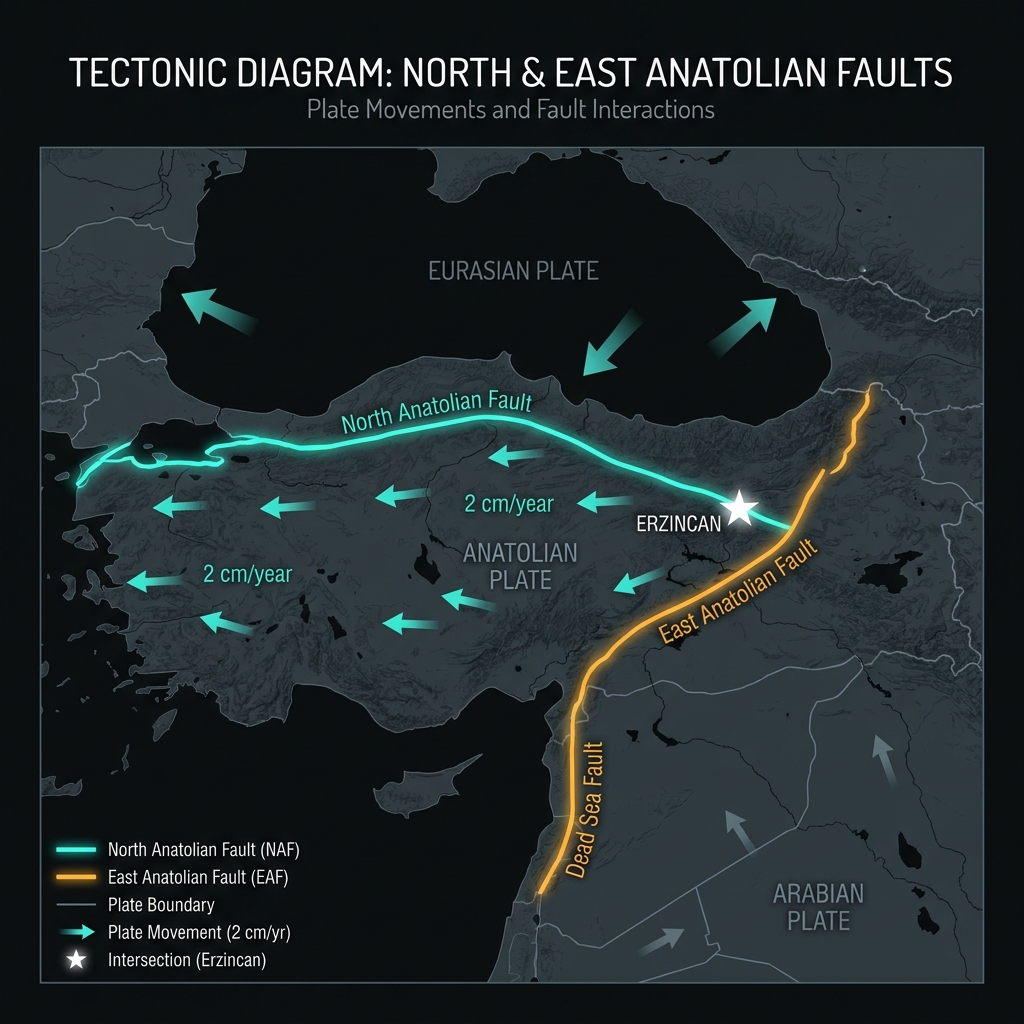
Erzincan sits at a geologically complex crossroads, caught between the North Anatolian Fault and the East Anatolian Fault. These massive strike-slip boundaries—where tectonic plates slide past one another horizontally—churn as the Anatolian Plate pushes westward against the Eurasian Plate at roughly two centimeters per year. That motion may seem glacial, but over decades, the accumulated strain builds until friction can no longer hold the rock together. The 1992 disaster originated on the North Anatolian Fault, a crack in the Earth’s crust that has produced multiple magnitude 7-plus events over the past century.
Since that fatal March day in 1992, the region has continued to accumulate stress, releasing it periodically through moderate earthquakes. The 2003 M6.4 near Bingöl and the M6.7 shock near Doğanyol in 2020 remind geologists that this is not a sleeping giant but a restless one. This latest swarm fits that pattern of persistent unrest. Over the past four decades, seismologists have recorded six significant events of magnitude 6 or greater within 200 kilometers of Üzümlü, including a M6.1 tremor in 2003 that struck just 24 kilometers away. Such clustering reveals a crust under constant negotiation, with small adjustments preventing—or sometimes precipitating—larger ruptures.
How Does Shallow Depth Intensify the Impact?
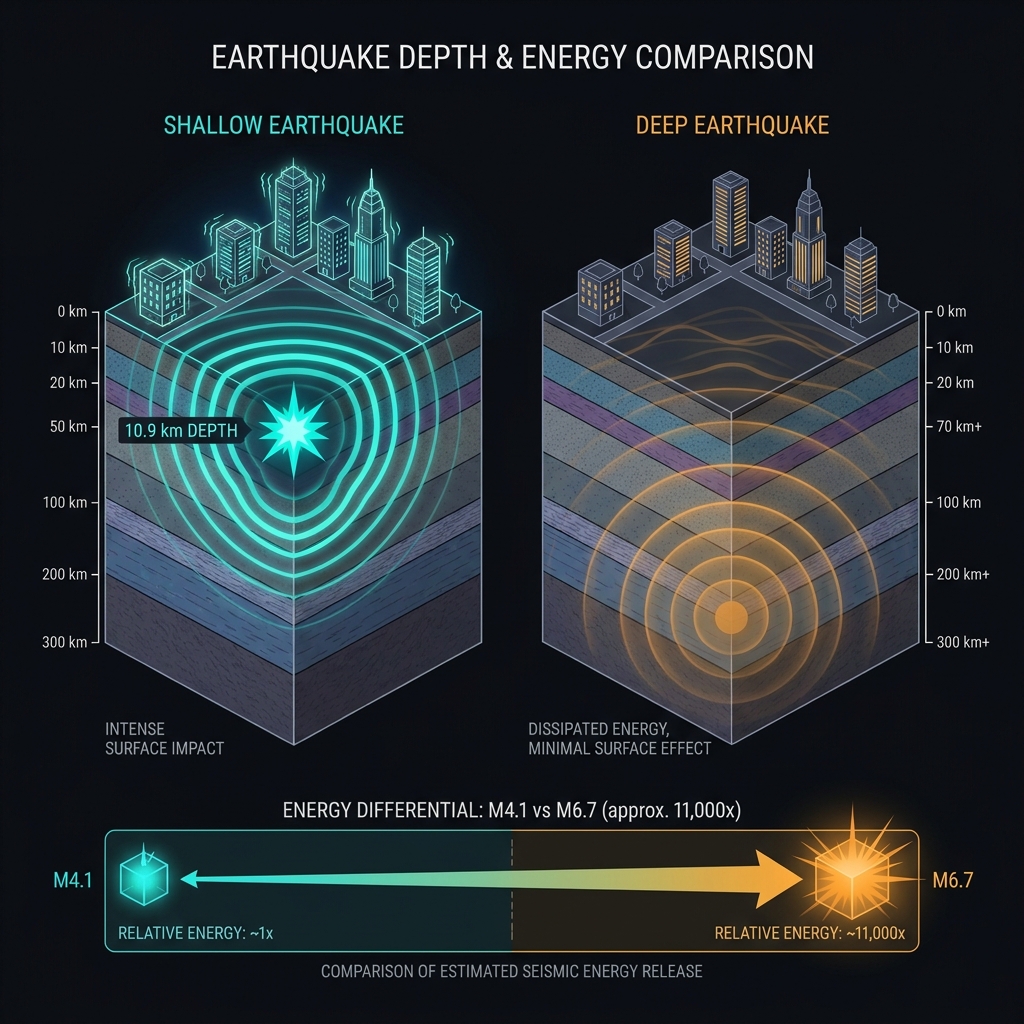
At 10.94 kilometers beneath the surface, Friday’s earthquake qualifies as shallow—meaning the energy released had less rock to dissipate through before reaching the surface. Seismologists classify earthquakes at depths less than 70 kilometers as shallow, and those under 15 kilometers often produce sharper, more localized shaking than deeper events of equivalent magnitude. Residents likely felt a sharp jolt followed by rolling motion, the seismic signature of brittle rock breaking near the surface.
To put the energy in perspective, the magnitude scale is logarithmic: each whole number increase represents roughly 32 times more energy release. Compared to the 1992 M6.7 event, this M4.1 quake released approximately 11,000 times less energy. Yet proximity matters as much as magnitude. The following table illustrates how this week’s activity compares to the region’s recent seismic character:
| Event | Magnitude | Depth | Approximate Distance from Üzümlü |
|---|---|---|---|
| April 17, 2026 (Largest Swarm Event) | 4.1 MW | 10.9 km | 0 km |
| 1992 Erzincan Earthquake | 6.7 | ~10 km | 9 km |
| 2003 Pulumer Earthquake | 6.1 | ~10 km | 24 km |
| 2020 Doğanyol Earthquake | 6.7 | ~12 km | 145 km |
While M4.1 earthquakes rarely cause structural damage to modern buildings, they serve as potent reminders of the forces lurking beneath relatively modest magnitudes when they occur near population centers. Seismologists classify this as a shallow crustal earthquake typical of transform boundaries, where the lack of thick sedimentary cover often allows even moderate events to feel surprisingly vigorous.
What Should We Watch For in the Coming Days?
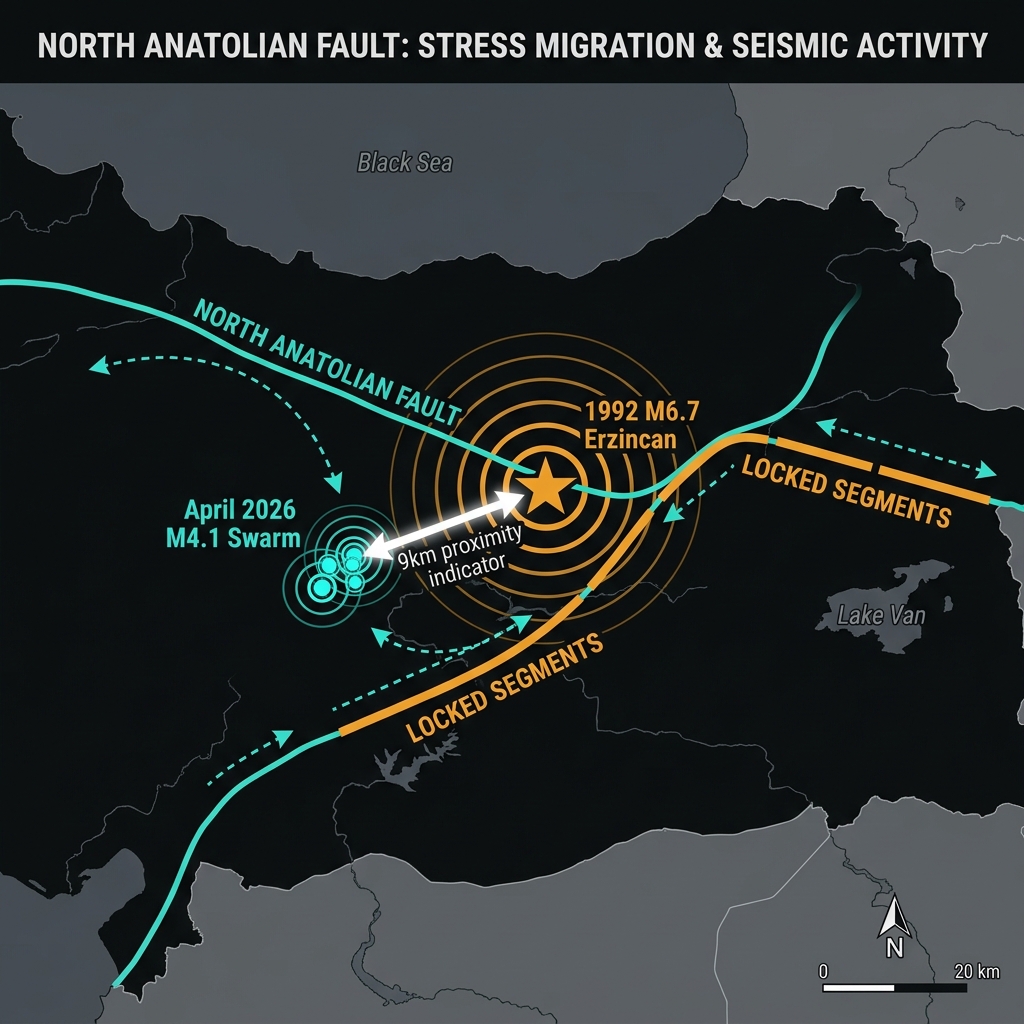
Seismologists will monitor this swarm closely for signs of escalation or decay. Swarm sequences—defined by clusters of earthquakes without a clear dominant mainshock—can persist for weeks or simply fade into the background radiation of minor tremors. Given the proximity to the 1992 rupture zone, researchers are particularly attentive to any migration of seismicity along the North Anatolian Fault. Such movement could indicate stress redistribution toward locked sections capable of generating significantly larger events. For now, the pattern suggests localized adjustment rather than a precursor to a major rupture, but in this part of Anatolia, the ground rarely keeps its secrets for long. Residents should expect intermittent aftershocks, though the probability of a substantially larger quake remains statistically low while not zero.
Frequently Asked Questions
How strong was this earthquake?
The event registered as magnitude 4.1 on the moment magnitude scale, a measurement that reflects the total energy released during the rupture. At this intensity, the shaking would have been felt indoors by most people and could have caused unstable objects to topple, though well-constructed buildings typically sustain no damage.
Is there a risk of a tsunami?
No tsunami threat exists from this earthquake. The epicenter lies deep within the Anatolian landmass, approximately 300 kilometers from the nearest coastline, and the mechanism of the fault movement—primarily horizontal strike-slip—does not displace sufficient water volume to generate ocean waves.
Why did this happen so close to the 1992 earthquake location?
The North Anatolian Fault system remains active long after major ruptures, with surrounding crust continuing to settle and adjust to the stress changes caused by the 1992 M6.7 event. This ongoing process of post-seismic deformation creates pockets of residual stress that release periodically, explaining why modern swarms often shadow the footprints of historical disasters.
Track this event live on the map!
Download GeoShake and get instant earthquake alerts.
Download GeoShake