
The ground beneath Bayat, a quiet district in Turkey’s Çorum Province, has not rested easy this week. On the morning of April 8, 2026, a shallow magnitude 4.0 earthquake struck at 10:20 AM local time, marking the most powerful tremor in a persistent seismic swarm that has produced 23 separate earthquakes in just seven days, according to USGS data. The event originated 11 kilometers beneath the surface—shallow enough to amplify the shaking across the region’s rolling Anatolian landscape.
Why Is This Region So Seismically Active?
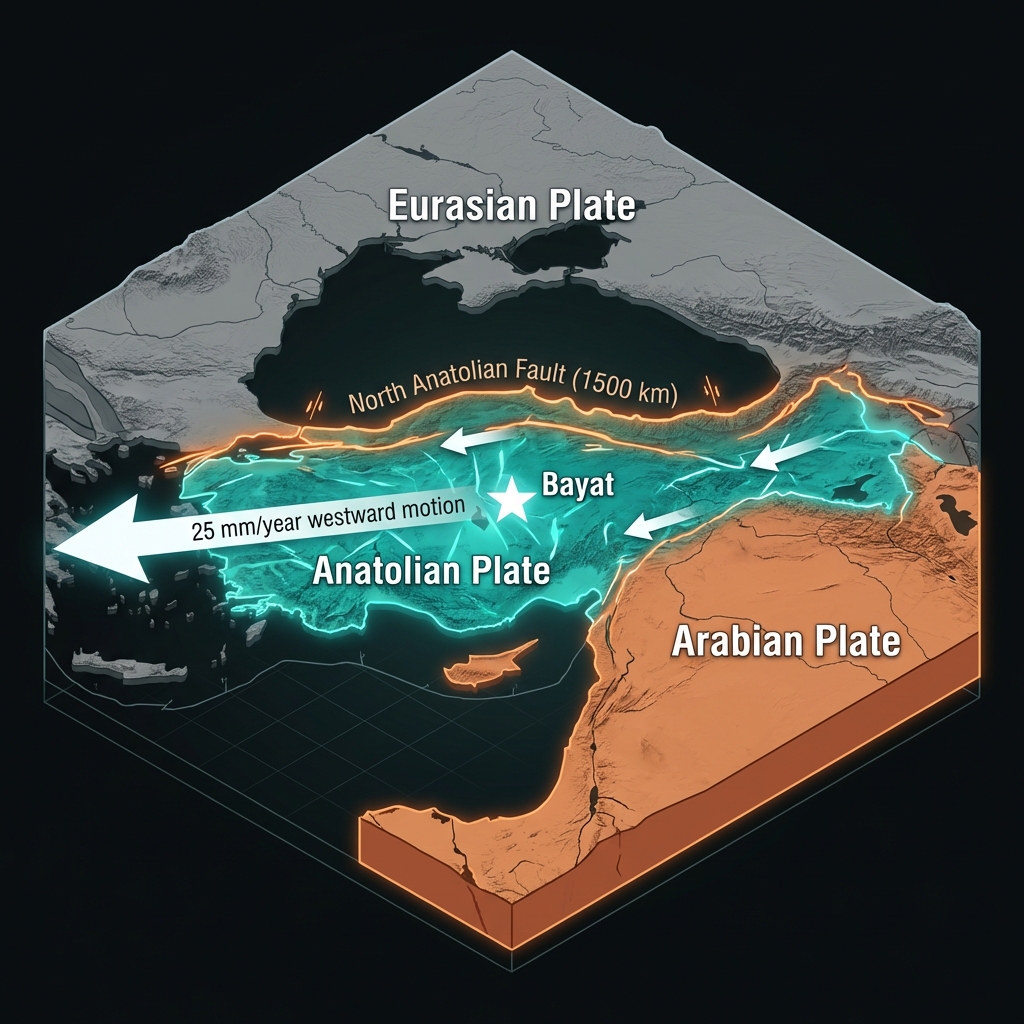
This corner of central Turkey sits at a complex intersection of tectonic forces. The Anatolian Plate, essentially a large block of Earth’s crust being squeezed westward between the Eurasian Plate to the north and the Arabian Plate to the south, moves approximately 25 millimeters each year as it escapes the collision zone created by the ongoing crash of Arabia into Eurasia. Seismologists classify this as an intraplate setting relative to the main plate boundaries, yet the stress from distant collisions propagates hundreds of kilometers inland, finding release along ancient fault lines buried beneath the region’s sedimentary basins.
The ghost of larger quakes looms here. In 2000, a magnitude 6.0 earthquake struck just 100 kilometers northwest of this week’s swarm near the town of Orta, killing dozens and damaging thousands of structures. That event ruptured along the broader North Anatolian Fault system—a 1,500-kilometer gash capable of producing devastating earthquakes. While this week’s activity occurs on different structural trends, it shares the same fundamental driver: the relentless tectonic compression that has shaped Turkey’s topography for millions of years.
What Does This Depth Mean for Residents?
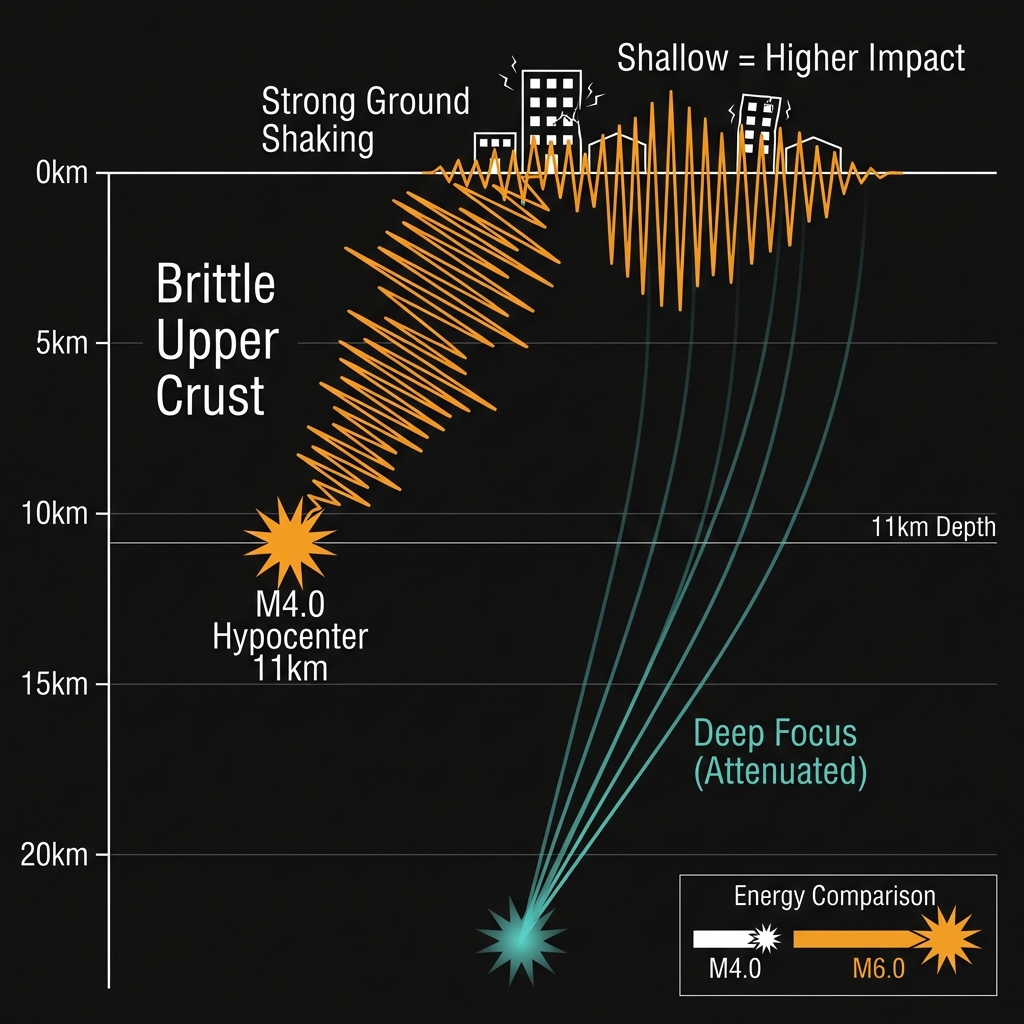
At 11 kilometers deep, this earthquake qualifies as shallow—originating within the brittle upper crust where rock behaves like rigid blocks rather than flowing plastic. Shallow quakes pack a punch. The energy travels shorter distances to reach the surface, experiencing less attenuation, or weakening, than deep-focus events that dissipate their force through kilometers of rock. Residents of Çorum likely experienced sharp, sudden jolts rather than the rolling motion typical of deeper, distant earthquakes.
To put the magnitude in perspective, a magnitude 4.0 event releases roughly the same energy as 1,000 tons of TNT—comparable to a small industrial explosion. While unlikely to cause significant damage to modern structures built to Turkey’s updated seismic codes, the shaking would have rattled windows and sent items swaying on shelves across Bayat and surrounding villages. The swarm’s cumulative effect, however, tells a different story. Over the past week, the region has experienced a sequence of 23 distinct tremors, a pattern seismologists recognize as a swarm rather than traditional foreshock-mainshock-aftershock sequences.
| Timeframe | Number of Events | Largest Magnitude | Depth Range |
|---|---|---|---|
| Past 7 days | 23 | M4.0 | ~11 km |
| April 8, 2026 | 1 (the M4.0) | M4.0 | 11.01 km |
| Historical context (2000) | 1 major event | M6.0 | Variable |
This type of earthquake tells us that local faults are adjusting to regional stress, releasing accumulated strain in small increments rather than storing it for one catastrophic rupture.
What Should We Watch For?
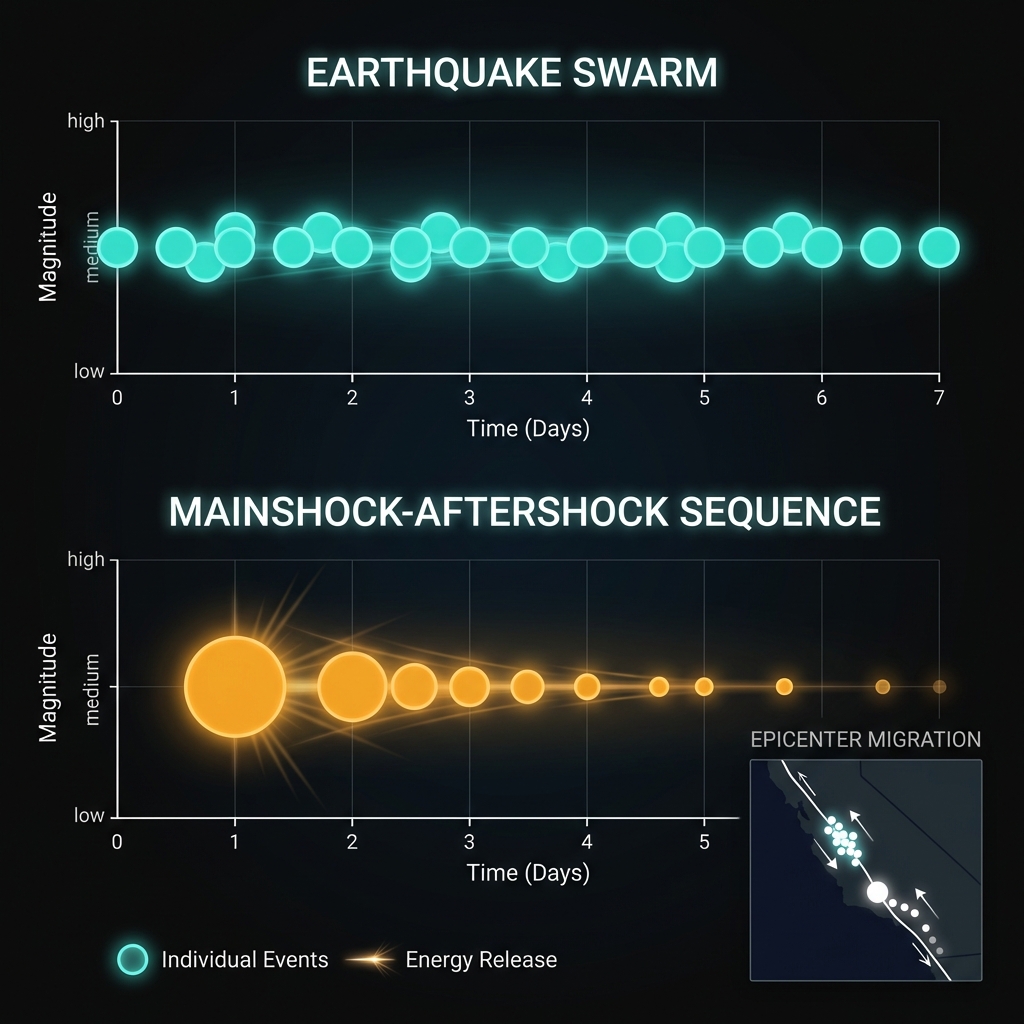
Earthquake swarms rarely follow the predictable decay patterns of aftershock sequences, making them particularly challenging to interpret. Unlike a mainshock, which dominates the energy release and is followed by progressively smaller tremors, swarms feature earthquakes of similar magnitudes clustering in time and space without a clear leader. Monitoring agencies will watch closely for any deviation—specifically, a sudden jump in magnitude or a migration of epicenters along a fault trace that might signal the preparation for a larger event.
For now, the activity remains within the bounds of normal tectonic adjustment for this region. The proximity to the 2000 Orta earthquake serves as a sobering reminder, however, that central Turkey’s faults are capable of much larger releases. Scientists will continue tracking the swarm’s evolution, looking for changes in depth, frequency, or magnitude that might indicate a shift from background seismicity to something more consequential.
Frequently Asked Questions
How strong was this earthquake?
The earthquake registered as magnitude 4.0 on the moment magnitude scale (Mw), making it a light earthquake capable of causing noticeable shaking indoors and rattling loose objects. It released approximately 1,000 times less energy than the magnitude 6.0 earthquake that struck near Orta in 2000.
Is there a tsunami risk from this event?
No tsunami warning was issued for this earthquake. Tsunamis typically require large undersea displacements of water, usually from magnitude 7.0+ earthquakes occurring beneath the ocean floor. This event struck 11 kilometers deep beneath landlocked central Turkey, far from any coastline.
Why is this area experiencing a swarm rather than a single large quake?
Seismic swarms occur when stress releases gradually along a fault system through many small earthquakes rather than accumulating into one major rupture. This behavior is common in regions with complex fault networks and high geothermal activity, where fluids or structural complexity prevent the clean, single-failure mechanism that produces isolated mainshocks.
Track this event live on the map!
Download GeoShake and get instant earthquake alerts.
Download GeoShake