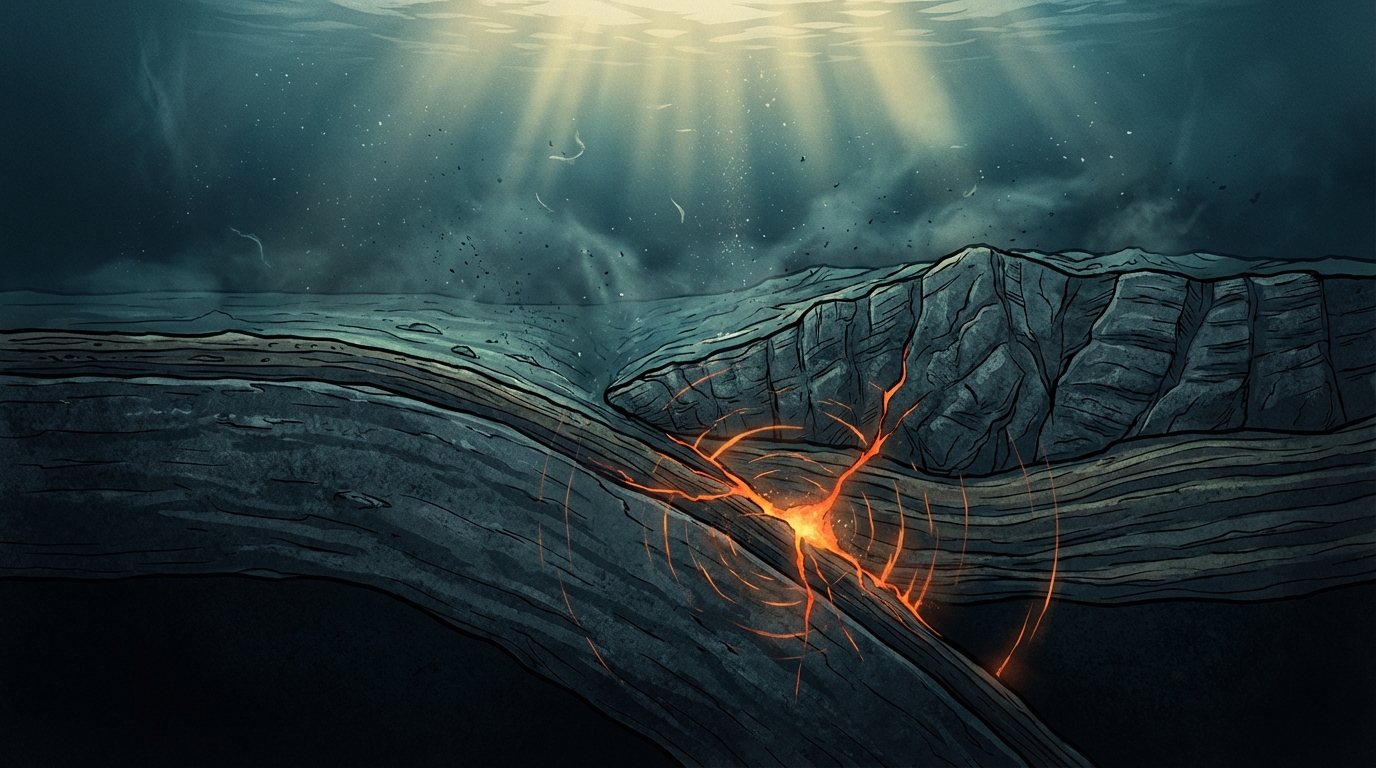
At 6:15 on a Saturday morning, the seafloor lurched. Ten kilometers beneath the surface of the Pacific Ocean—roughly the cruising altitude of a commercial airliner inverted into the depths—the earth’s crust fractured, releasing a magnitude 6.2 jolt roughly 102 kilometers northeast of Hihifo, Tonga. The shaking originated within the uppermost layer of the tectonic plate, shallow enough that the energy arrived at the surface with minimal dissipation, rattling the remote northern islands of the Tongan archipelago as the sun climbed above the horizon.
The Tonga Trench: A Collision Zone
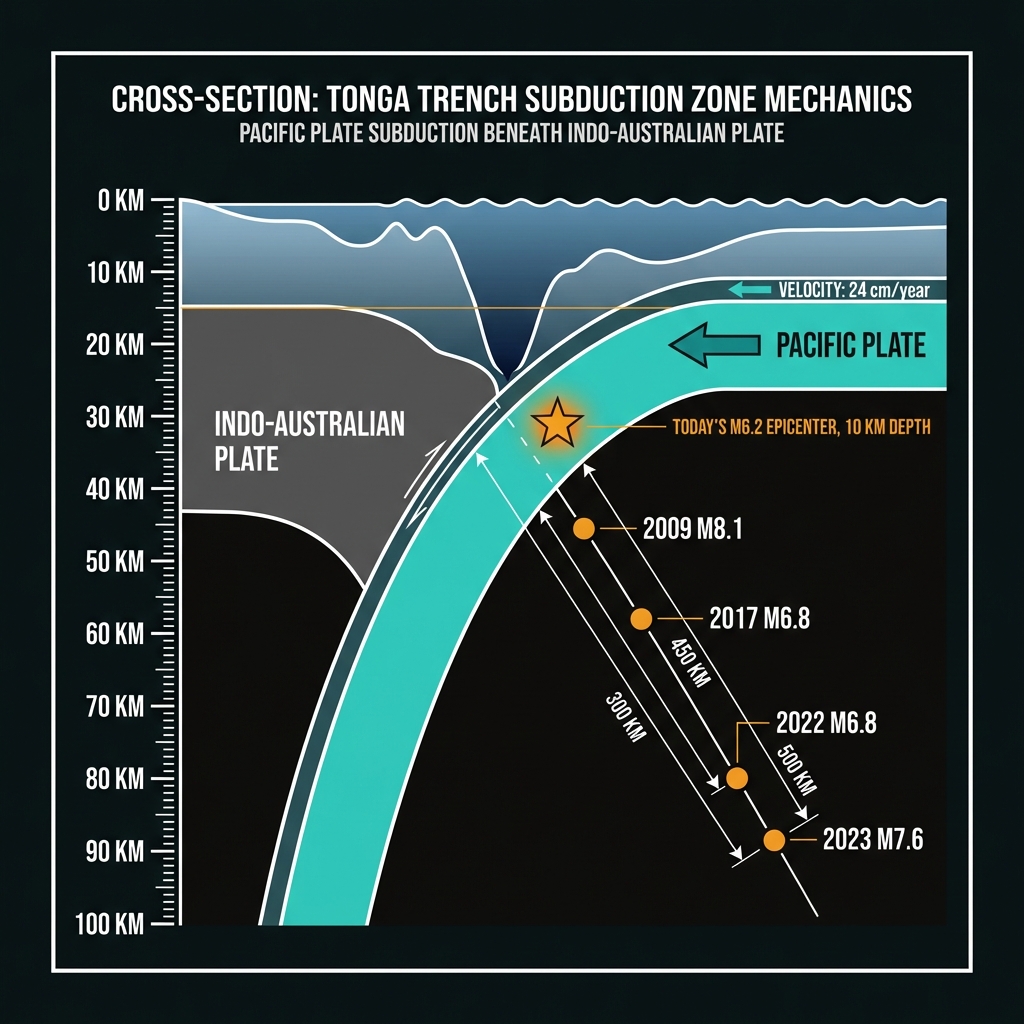
To understand this morning’s tremor, picture the Pacific Plate—a massive slab of oceanic crust marching westward at approximately 24 centimeters per year, roughly the rate at which fingernails grow. Here, along the Tonga Trench, that plate dives beneath the Indo-Australian Plate in a process geologists call subduction. The friction generated as these geological titans grind against one another builds stress until the rocks snap, sending seismic waves radiating outward.
This particular stretch of the Pacific “Ring of Fire” carries a long memory of rupture. In 2009, just 103 kilometers from today’s epicenter, an M8.1 earthquake unleashed a tsunami that claimed lives across Samoa, American Samoa, and Tonga. More recently, a powerful M7.6 struck 157 kilometers to the west-northwest in 2023. Historical records reveal a sobering pattern: since 1992, this 200-kilometer radius has experienced at least ten significant earthquakes of M6.6 or greater, including a M6.8 in 2022 that struck just 7 kilometers from today’s location and another M6.8 in 2017 merely 15 kilometers away. Seismologists classify this not as a statistical anomaly, but as the regular punctuation marks of an active subduction zone releasing accumulated strain.
Why Depth Changes Everything
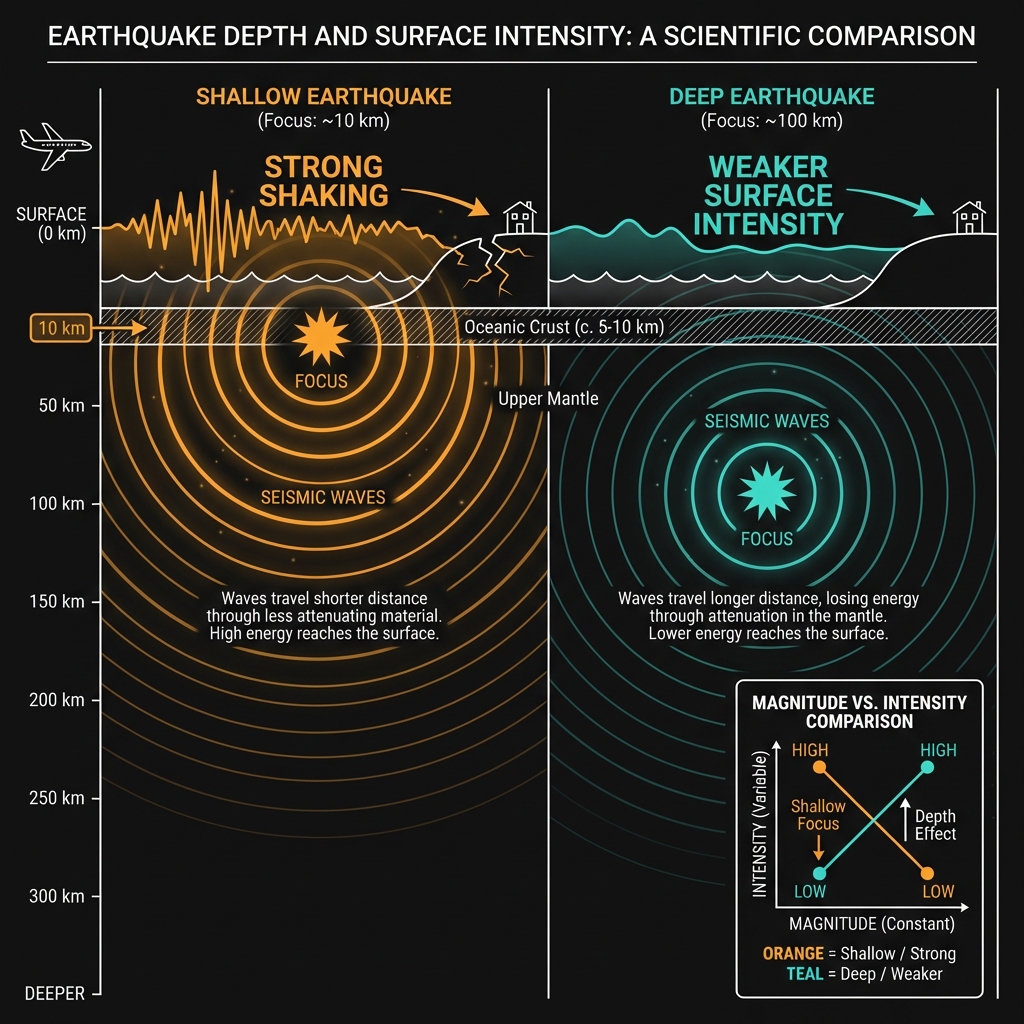
The practical impact of an earthquake depends heavily on its depth, and at ten kilometers, today’s event qualifies as dangerously shallow. When an earthquake ruptures this close to the surface, the seismic energy has less rock to travel through before reaching land or sea floor, resulting in stronger shaking than a deeper quake of equivalent magnitude might produce. Seismologists describe this using the concept of intensity—while magnitude measures the energy released at the source, intensity describes what humans actually feel.
Residents of the Niuas, the northernmost islands of Tonga, likely experienced strong to very strong shaking, with potential minor damage to traditional structures and temporary disruptions to unsecured objects. The shaking may have been perceptible as far away as Samoa, though with significantly diminished force. This event arrives amid a brief uptick in local activity: over the past seven days, seismometers have recorded two earthquakes in this region, making today’s M6.2 the largest in a short sequence that, while not constituting a swarm, suggests the crust has been particularly restless. Compared to the 2009 megathrust event, however, this is a minor stress release—a reminder that the trench accumulates energy constantly, releasing it in fits and starts ranging from these moderate shocks to the rare, devastating ruptures that reshape coastlines.
Immediate Precautions for Northern Tonga
For those in Hihifo and surrounding villages, specific vigilance is warranted in the coming hours. Inspect traditional wooden or masonry structures for fresh cracks in plaster or displaced foundations, as shallow earthquakes of this magnitude can destabilize buildings already weathered by tropical humidity and salt air. Check water tanks and storage vessels for leakage, and secure any propane tanks or hazardous materials that may have shifted. While authorities have confirmed no tsunami threat from this event, avoid low-lying coastal areas for the next few hours as a precaution against potential small, localized sea level disturbances. Most critically, treat the next 48 hours as an aftershock watch period—earthquakes of this size typically produce smaller follow-up tremors, and residents should sleep with shoes accessible and emergency supplies within reach, particularly given the region’s vulnerability to power interruptions.
The Ongoing Watch
As the day progresses, GeoShake’s monitoring networks will continue tracking the Tonga Trench for aftershocks or potential precursors to larger events. The planet’s most active boundaries rarely sleep, and today’s rupture—while significant—represents merely another chapter in the continuous, slow-motion collision that built these islands millions of years ago. In the Pacific’s geological calendar, the earth has once again cleared its throat, reminding us that we inhabit a world still very much in motion.
Track this event live on the map!
Download GeoShake and get instant earthquake alerts.
Download GeoShake