
Nearly 200 kilometers beneath the Hindu Kush mountains, the Earth stirred again. On April 3, 2026, a magnitude 5.8 earthquake ruptured deep within the subducting Indian Plate, just nine kilometers from the epicenter of a deadly M6.5 quake that struck the same unforgiving terrain in 2023, according to USGS data. The temblor struck at 11:42 p.m. local time, roughly 35 kilometers south of the small Afghan town of Jurm, a region where the ground has repeatedly proven itself to be anything but solid.
Why Is This Region So Seismically Active?
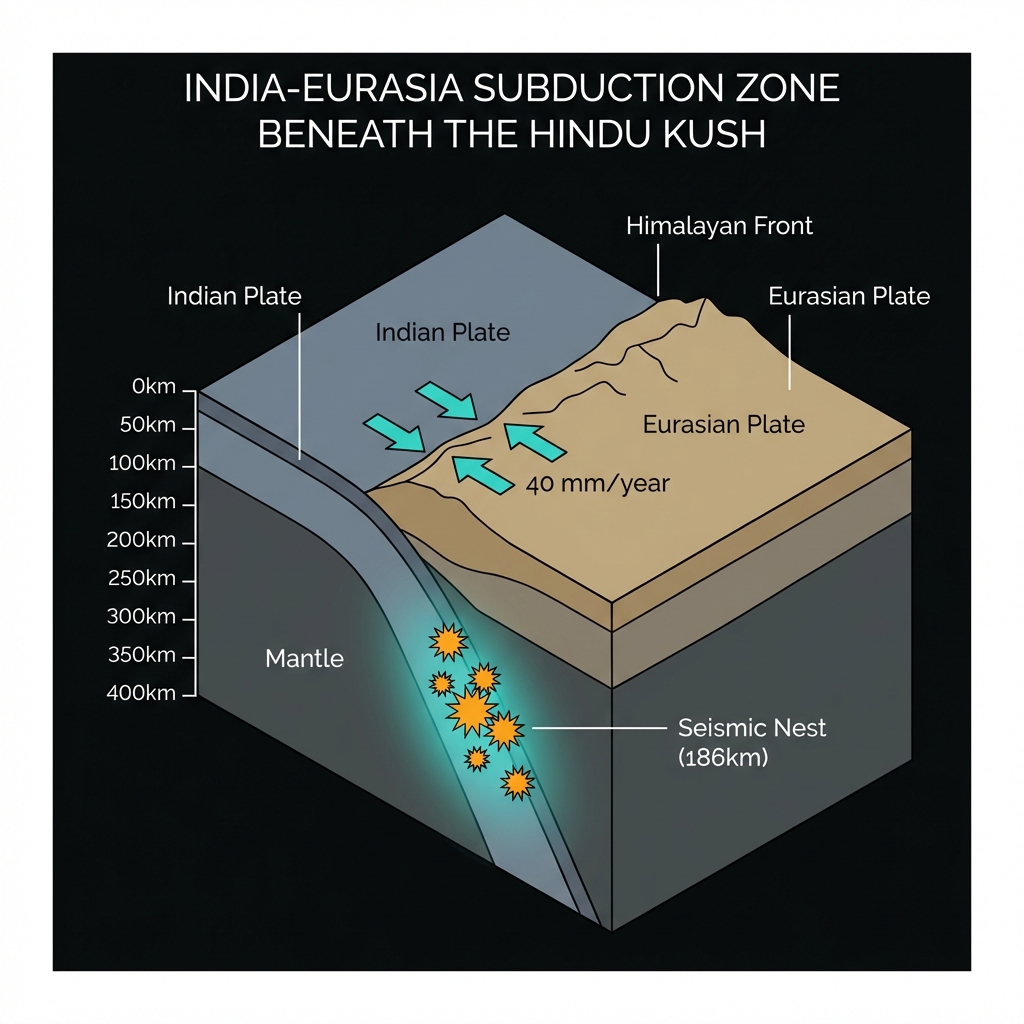
The Hindu Kush mountains are not merely a geographic barrier but a battleground of tectonic proportions. Here, the Indian Plate is subducting—sliding beneath—the Eurasian Plate at a rate of roughly 40 millimeters per year, creating one of the world’s most active intermediate-depth seismic zones. This process generates earthquakes tens to hundreds of kilometers below the surface, far deeper than the shallow ruptures that typically devastate California or Turkey.
The collision, which began roughly 50 million years ago when the Indian Plate slammed into Asia, continues to push the Himalayas skyward while simultaneously forcing dense oceanic crust downward into the mantle. This descending slab remains cool and brittle enough to fracture even at depths exceeding 200 kilometers, creating a unique seismic environment where earthquakes originate far below the surface crust. The region’s history reads like a catalog of tectonic violence: the 2015 M7.5 killed over 300 people across Afghanistan and Pakistan, while the 2002 M7.4 and 1993 M7.0 events caused significant regional damage. Even the 2023 M6.5, located a mere nine kilometers from this latest rupture, resulted in fatalities and structural collapse across remote mountain villages.
What Does 186 Kilometers Depth Mean For Surface Shaking?
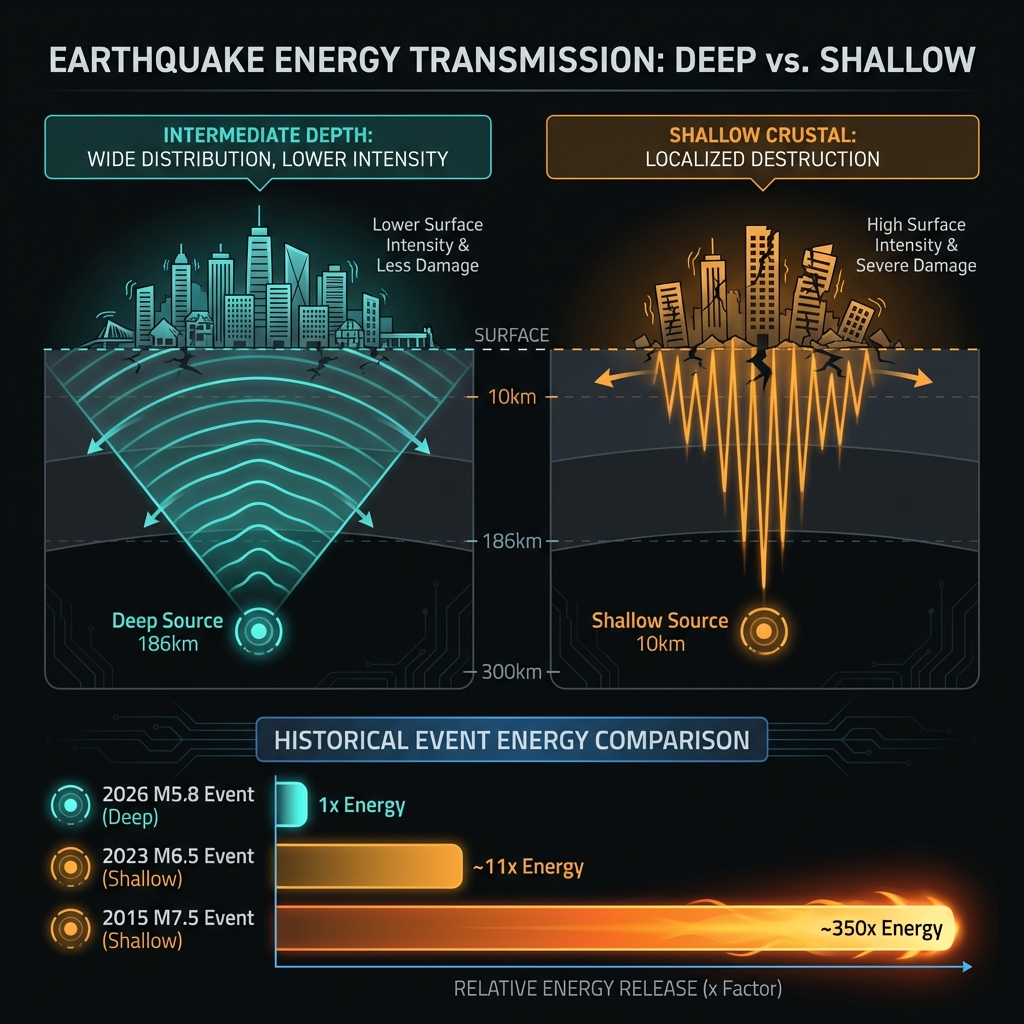
Seismologists classify earthquakes between 70 and 300 kilometers as intermediate-depth, distinct from shallow crustal quakes that cause the most localized destruction. At 186 kilometers down, the rupture released energy that traveled upward through nearly 200 kilometers of solid rock, significantly dampening the shaking before it reached human settlements. Unlike the sharp, jarring impacts of a shallow San Andreas Fault quake, residents in Kabul—roughly 250 kilometers south—likely experienced a slow, rolling motion lasting several seconds, similar to the sway of a large ship.
The depth acts as a natural shock absorber, distributing energy over a wider geographic area but with less intensity at any single point. The 2023 M6.5 event, occurring at a comparable depth just nine kilometers away, produced similar widespread sensations but released approximately 11 times more seismic energy. This illustrates the logarithmic nature of magnitude scales, where each whole number increase represents roughly 32 times the energy release.
| Feature | April 2026 Event | March 2023 Event | 2015 Hindu Kush Quake |
|---|---|---|---|
| Magnitude | M5.8 | M6.5 | M7.5 |
| Depth | 186 km | ~190 km | 231 km |
| Distance from Jurm | 35 km S | 40 km SSE | 43 km |
| Relative Energy | 1x | ~11x | ~350x |
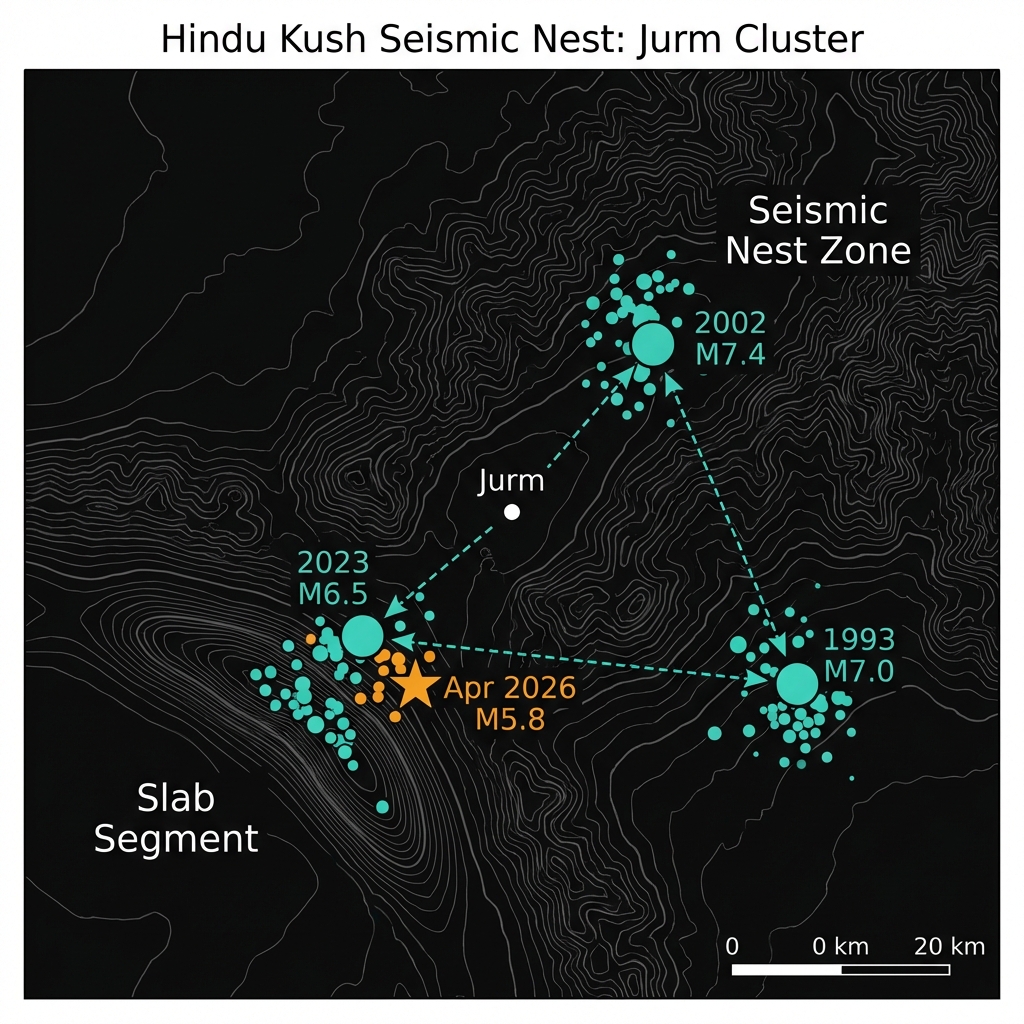
Seismologists note that this event falls within the Hindu Kush “seismic nest,” a zone where the subducting slab is deforming and breaking as it descends. The proximity to the 2023 epicenter suggests these may be stress adjustments within the same slab segment, rather than independent failures. When one section of the descending plate ruptures, it redistributes stress to neighboring locked portions. The 1993 M7.0 occurred just 19 kilometers from this latest rupture, and the 2002 M7.4 only 33 kilometers distant, painting a picture of a subduction zone that releases energy in localized clusters over decades.
What Should We Watch For Now?
For a deep earthquake of this magnitude, significant aftershocks are less common than with shallow crustal quakes, though the region will likely experience several smaller tremors in the coming weeks. The greater concern remains the inevitable next large event. With the Indian Plate continuing its relentless northward push, the Hindu Kush will certainly host future magnitude six and seven earthquakes. Monitoring networks continue to watch for subtle changes in seismic patterns that might signal increasing stress, but in this region, the question is not if the ground will shake again, but when and exactly where along the descending slab the next rupture will occur.
Frequently Asked Questions
How strong was this earthquake?
The earthquake registered as magnitude 5.8, which seismologists consider moderate. Because it occurred at 186 kilometers depth, the shaking felt at the surface was significantly attenuated compared to a shallow quake of the same magnitude, though it was likely felt over a broad area including parts of Afghanistan, Tajikistan, and Pakistan.
Is there a tsunami risk from earthquakes in the Hindu Kush?
No. Tsunamis require vertical displacement of the seafloor during underwater earthquakes, typically at shallow depths along oceanic trenches. This earthquake occurred deep beneath continental landmass at 186 kilometers depth, and the region is landlocked, eliminating any tsunami threat entirely.
Why does this area experience such deep earthquakes?
The Hindu Kush sits above a subduction zone where the Indian Plate is diving beneath the Eurasian Plate. As the dense oceanic crust descends into the hot mantle, it remains cool and brittle enough to fracture and generate earthquakes at depths exceeding 200 kilometers, creating what scientists call an intermediate-depth seismic zone.
Track this event live on the map!
Download GeoShake and get instant earthquake alerts.
Download GeoShake