
Just after 7:52 AM local time on April 6th, the ground beneath Turkey’s Hatay province shuddered at a depth of just 7.8 kilometers—shallow enough that the seismic energy had barely dissipated before reaching the surface. According to USGS data, the magnitude 4.3 tremor struck near the coastal district of Akdeniz, sending a jolt through a landscape still scarred by the February 2023 earthquake that claimed more than 20,000 lives in this province alone. For residents navigating the slow, painful process of rebuilding, the shallow quake served as a visceral reminder that the geological forces which reshaped their world three years ago remain restless.
Why Is This Region So Seismically Active?
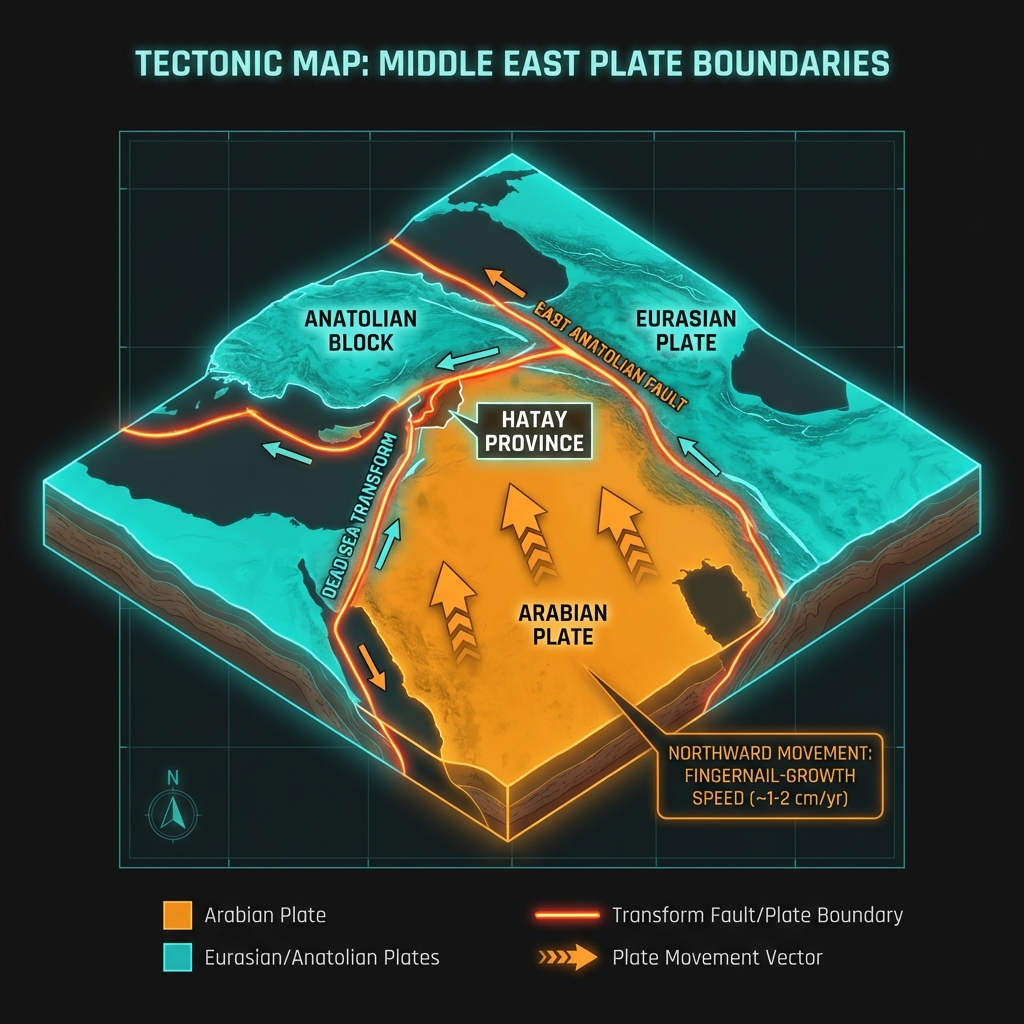
Hatay sits at a treacherous intersection of tectonic plates, where the Arabian Peninsula grinds northward into Eurasia at roughly the rate your fingernails grow each year. This collision, part of the broader Alpide belt stretching from the Atlantic to the Himalayas, has fractured the crust into a complex web of faults including the East Anatolian Fault and the Dead Sea Transform. Seismologists classify this as a continental transform boundary, where massive crustal blocks slide past one another rather than colliding head-on, storing enormous elastic strain that releases suddenly as earthquakes.
The February 2023 magnitude 7.8 event ruptured along a segment of the East Anatolian Fault system, and today’s tremor occurred within the same broad deformation zone. While magnitude 4.3 events are orders of magnitude smaller than the 2023 disaster, they represent the ongoing adjustment of stress within the crust—either as aftershocks to the mainshock years later, or as independent ruptures on adjacent fault segments triggered by the regional redistribution of tectonic forces. This type of earthquake tells us that the fault system remains loaded with stress, continuing to seek equilibrium through these smaller, more frequent releases.
What Does Such a Shallow Depth Mean for Residents?
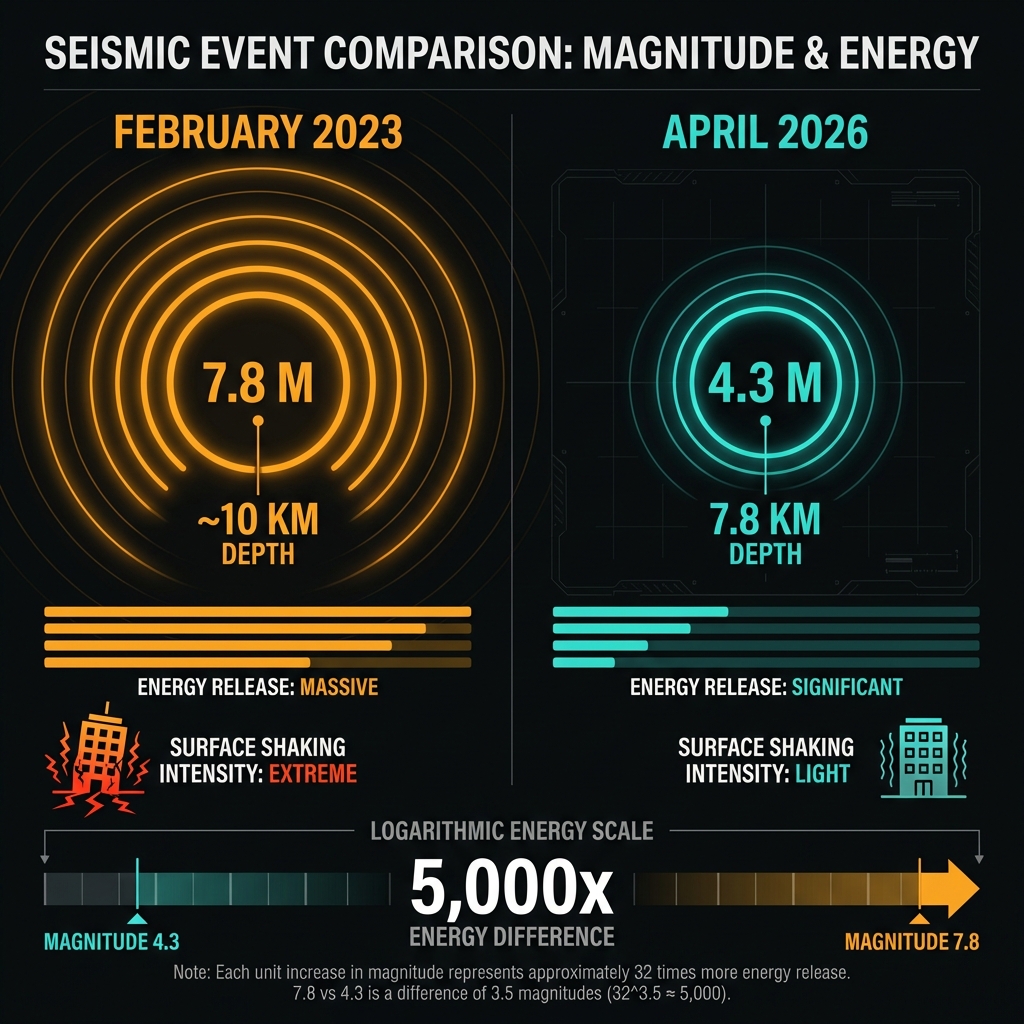
Depth is everything in seismology. At 7.8 kilometers, this earthquake qualifies as very shallow—originating within the brittle upper crust where rocks break abruptly rather than flowing plastically. Seismologists classify earthquakes at less than 70 kilometers as shallow, but anything under 10 kilometers delivers energy to the surface with minimal attenuation, meaning the shaking feels significantly more intense than a deeper quake of equivalent magnitude.
To put this in perspective, the devastating February 2023 earthquake struck at a similarly shallow depth of approximately 10 kilometers. While today’s magnitude 4.3 released roughly 5,000 times less energy than the 2023 event, the shallow origin means residents within 20 kilometers of Akdeniz likely experienced strong perceptible shaking—equivalent to the jolt of a heavy truck colliding with a building, or items falling from shelves. Reports from the region suggest the tremor was felt as far as Antakya, the provincial capital still rebuilding from the 2023 devastation.
| Seismic Event | Magnitude | Depth | Relative Energy Release |
|---|---|---|---|
| April 6, 2026 | 4.3 ML | 7.8 km | 1x (baseline) |
| February 2023 | 7.8 | ~10 km | ~5,000x |
What Should We Watch For Now?
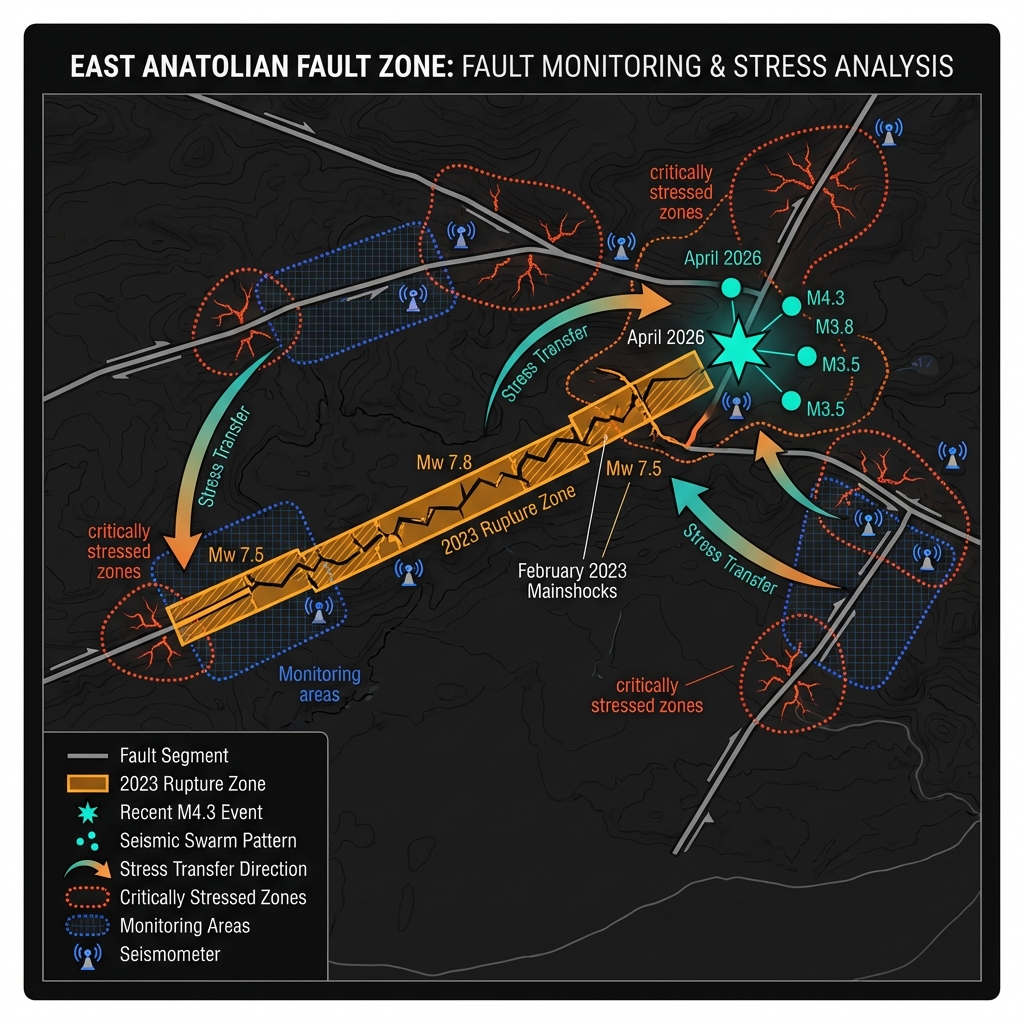
In the coming days, seismologists will monitor whether this event represents an isolated stress release or part of a broader sequence. The region has experienced three earthquakes in the past week, suggesting a possible swarm—clusters of small tremors indicating fluid migration or minor fault adjustments—though today’s magnitude 4.3 dominates the recent record. While aftershocks from the 2023 mainshock continue to diminish in frequency, shallow earthquakes of this size can occasionally trigger cascading failures on nearby critically stressed faults. Engineers and urban planners in Hatay will be watching closely; each tremor tests the structural integrity of buildings constructed under post-2023 seismic codes, offering real-world data on whether the new standards hold when the ground moves.
Frequently Asked Questions
How strong was this earthquake?
The earthquake registered as magnitude 4.3 on the local magnitude (ML) scale, a moderate event detectable across Hatay province but typically causing only minor damage to poorly constructed buildings. While the shaking was strong enough to rattle nerves in a traumatized region, it released approximately one five-thousandth of the energy of the catastrophic 2023 earthquake.
Is there a risk of a tsunami?
No tsunami warning was issued for this event. The earthquake originated inland beneath Hatay province, far from the submarine trenches that typically generate tsunamis. Even coastal earthquakes in this region rarely produce significant tsunamis due to the limited vertical displacement of the seafloor during strike-slip faulting.
Why is this specific area so prone to earthquakes?
Hatay lies at the junction of the East Anatolian Fault and the Dead Sea Transform, where the Arabian plate slides past the Anatolian block. This tectonic geometry creates a complex zone of horizontal shear stress that periodically releases as earthquakes, ranging from small tremors like today’s event to the magnitude 7.8 disaster that struck the same province in February 2023.
Track this event live on the map!
Download GeoShake and get instant earthquake alerts.
Download GeoShake