The earth cracked at a depth of nearly 200 kilometers on March 25, 2026, releasing a magnitude 5.2 tremor just three kilometers from the exact spot where a catastrophic magnitude 7.6 earthquake devastated Tonga in 2023. Striking 80 kilometers west-northwest of Hihifo at 198 kilometers below the Pacific seafloor, according to USGS data, this intermediate-depth event offers a rare glimpse into the ongoing reorganization of stress within one of the planet’s most aggressive subduction zones. Unlike its shallow predecessor that unleashed destructive tsunami waves three years prior, this deep adjustment occurred within the belly of the descending Pacific Plate itself—an intraslab earthquake signaling that the geological machinery beneath Tonga continues to grind and resettle.
Why Is This Subduction Zone So Volatile?
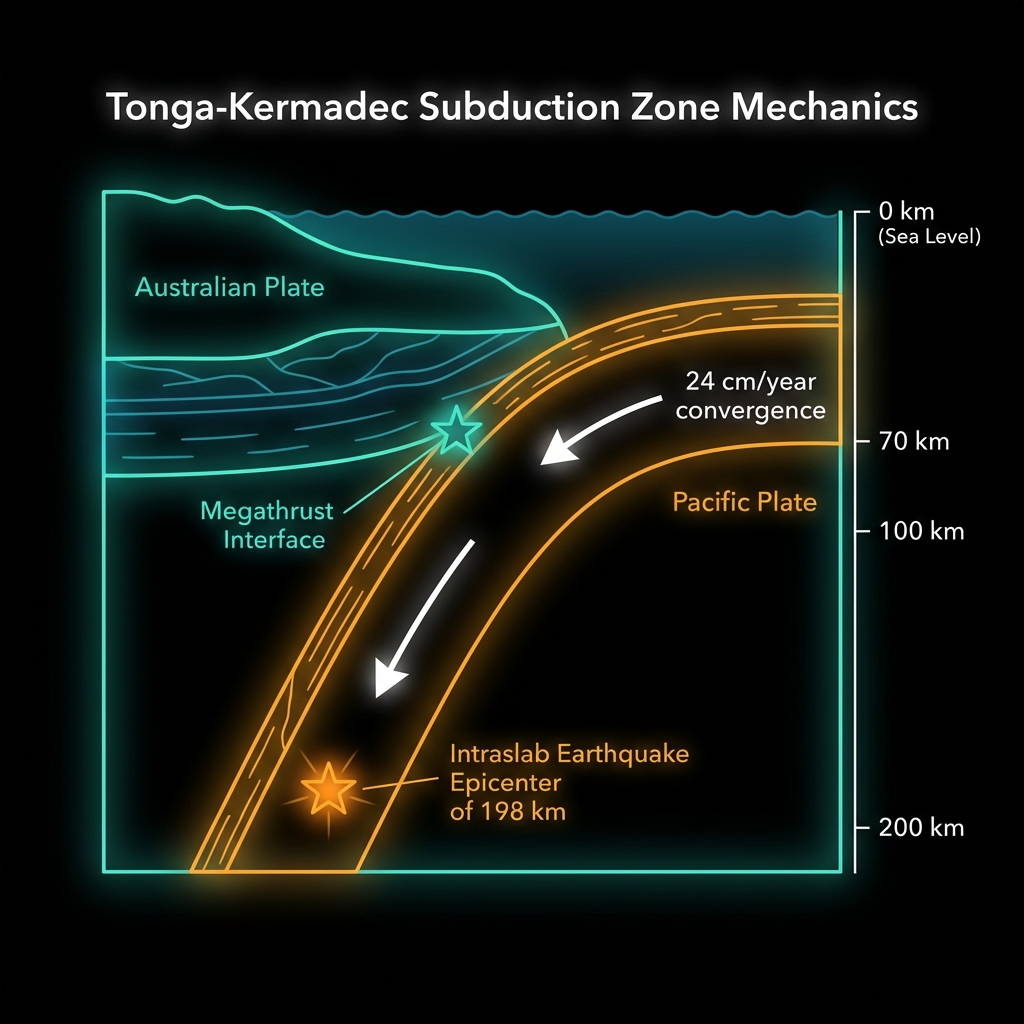
The Tonga-Kermadec trench marks a convergence zone of extraordinary violence, where the Pacific Plate dives beneath the Australian Plate at speeds exceeding 24 centimeters annually—faster than the growth rate of human fingernails, yet geologically blistering. This descent creates a “slab” of oceanic crust that penetrates deep into the mantle, generating earthquakes across a spectrum of depths from shallow crustal fractures to these intermediate events occurring between 70 and 300 kilometers down. Seismologists classify this particular event as an intraslab earthquake, meaning it ruptured within the subducting plate rather than at the locked interface between the two colliding masses.
The region’s recent memory includes significant trauma: the destructive 2023 magnitude 7.6 event, a magnitude 6.8 rupture in 2022, and a magnitude 6.6 tremor just last year. Each represents different stages of stress accumulation along this volatile boundary, where the relentless descent of cold oceanic lithosphere into the hot mantle creates a brittle, breaking environment capable of producing both shallow megathrust disasters and these deeper, more enigmatic adjustments.
What Does 198 Kilometers of Depth Mean for Those Above?
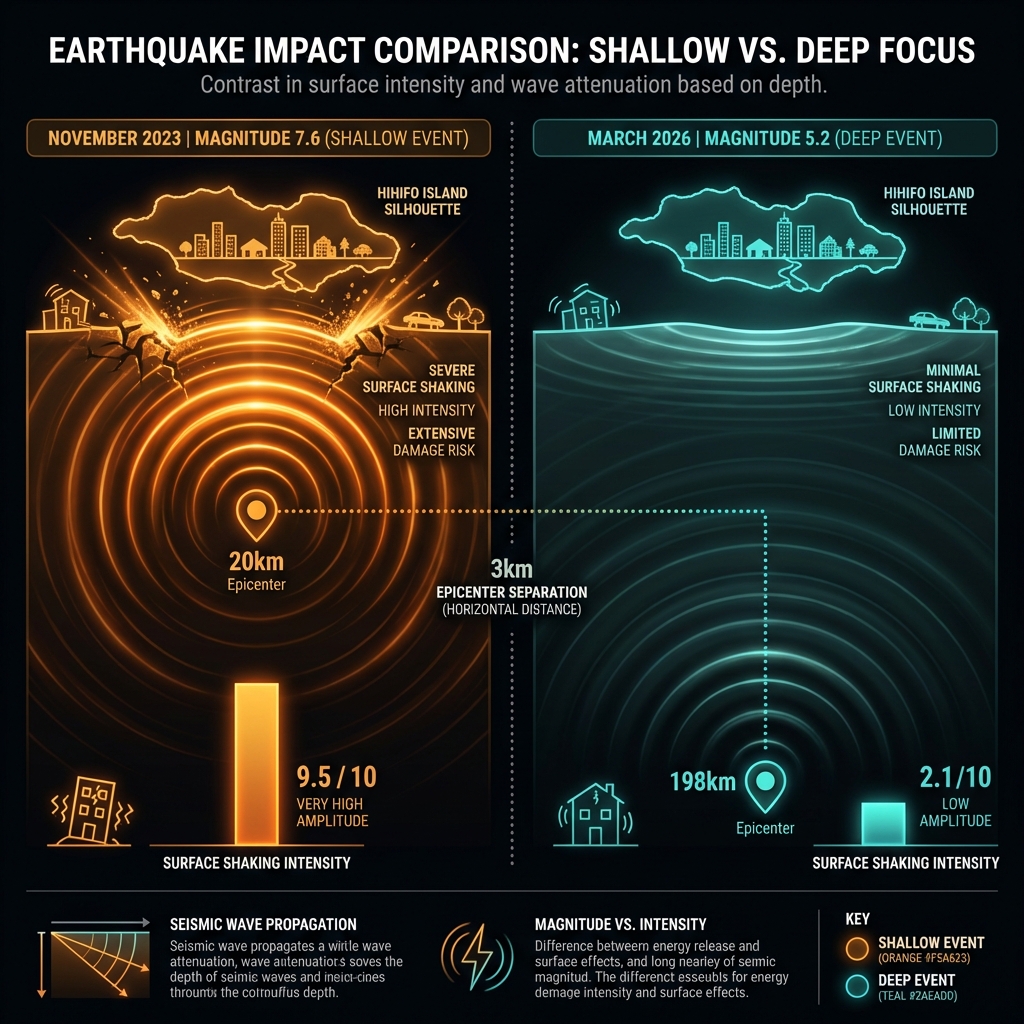
Depth acts as a natural shock absorber. While the 2023 magnitude 7.6 earthquake ruptured near the surface—unleashing intense shaking and tsunami energy across the archipelago—this week’s magnitude 5.2 event originated nearly four times deeper within the mantle. At 198 kilometers down, seismic waves must propagate through hundreds of kilometers of dense rock before reaching inhabited islands, significantly attenuating the shaking felt at the surface. Residents of Hihifo likely experienced no more than gentle tremors, if anything at all, despite the event’s moderate magnitude.
This contrasts sharply with the shallow magnitude 6.2 earthquake recorded just days earlier at 10 kilometers depth as part of an ongoing swarm of eleven earthquakes. That shallow event delivered far more perceptible jolts to nearby populations despite differing by only one magnitude unit, illustrating how depth often trumps magnitude in determining human impact. Seismologists classify earthquakes at this 198-kilometer depth as “intermediate-focus,” distinct from shallow crustal quakes that pose the greatest direct hazard to infrastructure.
| Characteristic | November 2023 Event | March 2026 Event |
|---|---|---|
| Magnitude | 7.6 | 5.2 |
| Depth | Shallow (~20-30 km) | 198 km |
| Distance from Hihifo | 82 km WNW | 80 km WNW |
| Epicenter Separation | — | 3 km |
| Tsunami Generated | Yes | No |
| Mechanism | Megathrust/interface | Intraslab |
Seismologists interpret this spatial clustering as evidence of stress redistribution following major ruptures. When the 2023 magnitude 7.6 event tore through the shallow portion of the subduction zone, it altered the stress field both updip toward the trench and downdip into the deeper slab. This recent magnitude 5.2 earthquake likely represents the Pacific Plate adjusting to these new forces, fracturing internally as the cold, brittle lithosphere encounters increasing temperature and pressure at mantle depths. This type of earthquake tells us that subduction is not a smooth conveyor belt but a brittle, breaking process where the descending plate actively deforms through thermal stress and mineral phase changes occurring nearly 200 kilometers beneath our feet.
What Should We Watch For Next?
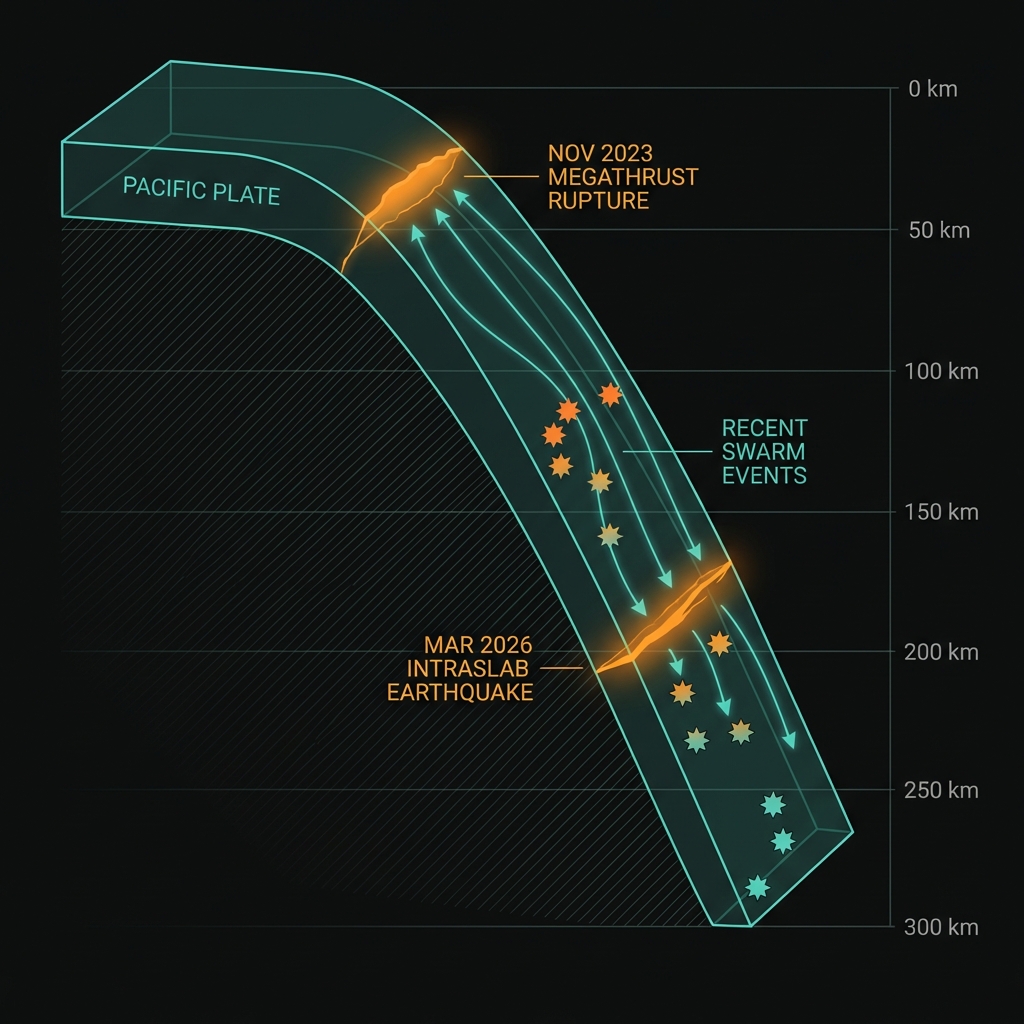
The current seismic swarm encompassing eleven earthquakes within the past week—including this deep event and the shallow magnitude 6.2 tremor—suggests the Tonga-Kermadec system is undergoing complex three-dimensional readjustment. While magnitude 5 intraslab events rarely trigger larger catastrophes, their occurrence within a swarm context indicates that stress is migrating through both the crust and the descending mantle lithosphere. Scientists will monitor whether this deep adjustment represents an isolated stress release or signals a broader sequence of deformation migrating along the slab. For Pacific nations, these events underscore that seismic hazard extends far below the surface, rooted in the ongoing collision of tectonic plates that will continue to reshape the region for millennia.
Frequently Asked Questions
How strong was this earthquake?
The earthquake registered as magnitude 5.2, a moderate event on the global seismic scale. However, because it originated at 198 kilometers depth, the actual shaking experienced at the surface was considerably weaker than a shallow quake of similar magnitude, likely noticed only as subtle vibrations by residents of nearby islands.
Is there a tsunami risk from deep earthquakes like this?
No tsunami warning was issued for this event, and deep earthquakes of this type rarely generate tsunamis. Unlike shallow megathrust earthquakes that can abruptly displace massive volumes of ocean water, tremors occurring at 198 kilometers depth do not produce sufficient seafloor displacement to create tsunami waves.
Why did this earthquake strike so close to the 2023 disaster site?
The three-kilometer proximity to the 2023 magnitude 7.6 epicenter reflects the ongoing process of stress redistribution within the Tonga-Kermadec subduction zone. Following major ruptures, the surrounding crust and descending plate continue to adjust as forces rebalance, often generating smaller earthquakes near previous large events as the system settles into a new equilibrium.
Track this event live on the map!
Download GeoShake and get instant earthquake alerts.
Download GeoShake