
Lead
The seafloor northeast of Tonga convulsed at 6:02 UTC this morning, releasing a magnitude 5.8 jolt from just 10 kilometers beneath the surface—shallow enough to deliver a sharp, damaging punch to the remote Niuas island group. Striking 112 kilometers northeast of Hihifo, the tremor arrived without triggering a tsunami, yet its proximity to both the ocean floor and a magnitude 6.3 foreshock from earlier this week raises immediate concerns about structural stability across these vulnerable Pacific outposts.
Context
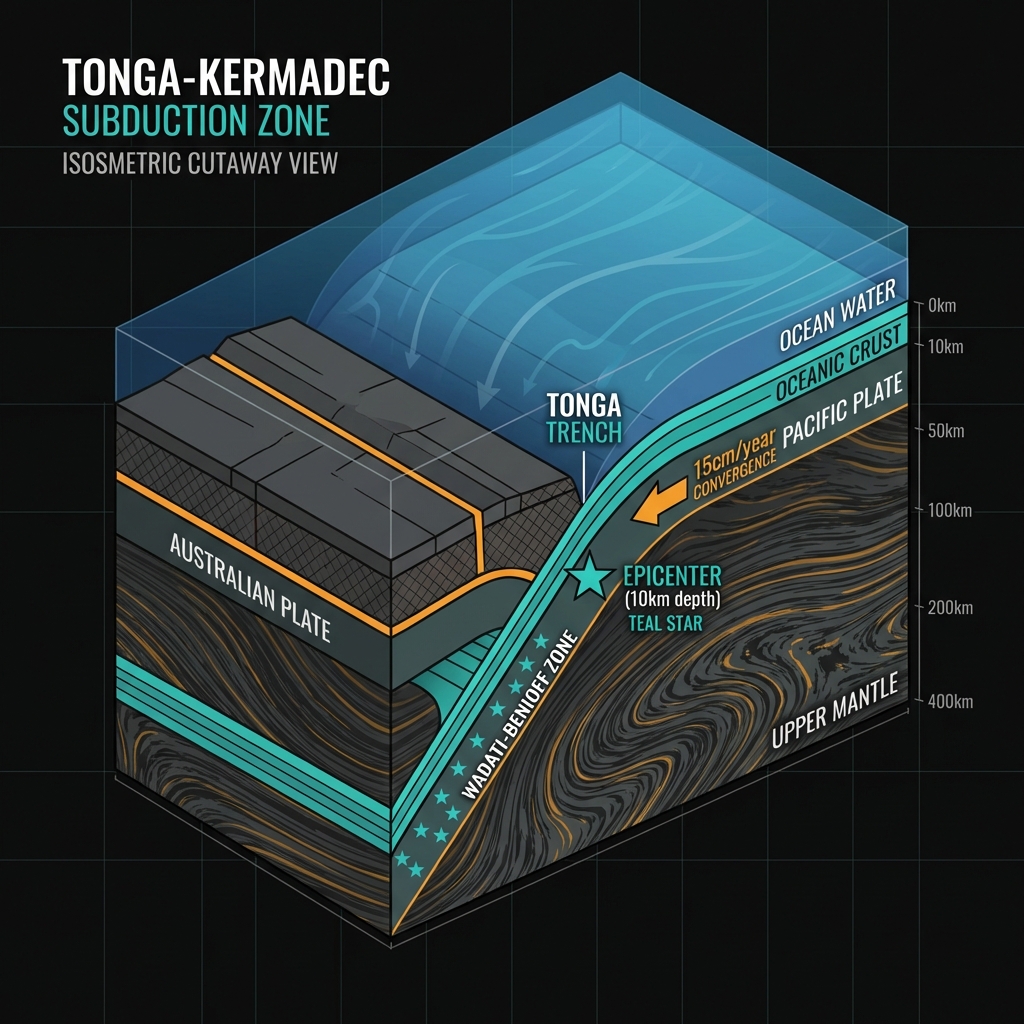
This rupture occurred along the Tonga-Kermadec subduction zone, a violent trench where the Pacific Plate dives beneath the Australian Plate at rates exceeding 15 centimeters per year—among the fastest convergence on Earth. The region carries a traumatic memory: in 2009, a magnitude 8.1 earthquake struck just 92 kilometers from today’s epicenter, generating a tsunami that claimed nearly 200 lives across Samoa and Tonga. More recently, a magnitude 7.6 event in 2023 ruptured 168 kilometers to the west, while a magnitude 6.8 quake shook this exact vicinity in 2022, located merely 5 kilometers from today’s epicenter.
Seismologists classify today’s event as a shallow-focus earthquake, distinct from the deeper “intraslab” tremors common to this arc. At 10 kilometers depth, the rupture likely occurred within the upper portion of the subducting slab or the overriding crust, rather than at the main plate interface capable of producing megathrust tsunamis. This shallow positioning explains the crisp, high-frequency shaking felt locally, contrasting with the rolling motions of deeper, distant quakes.
Impact Analysis
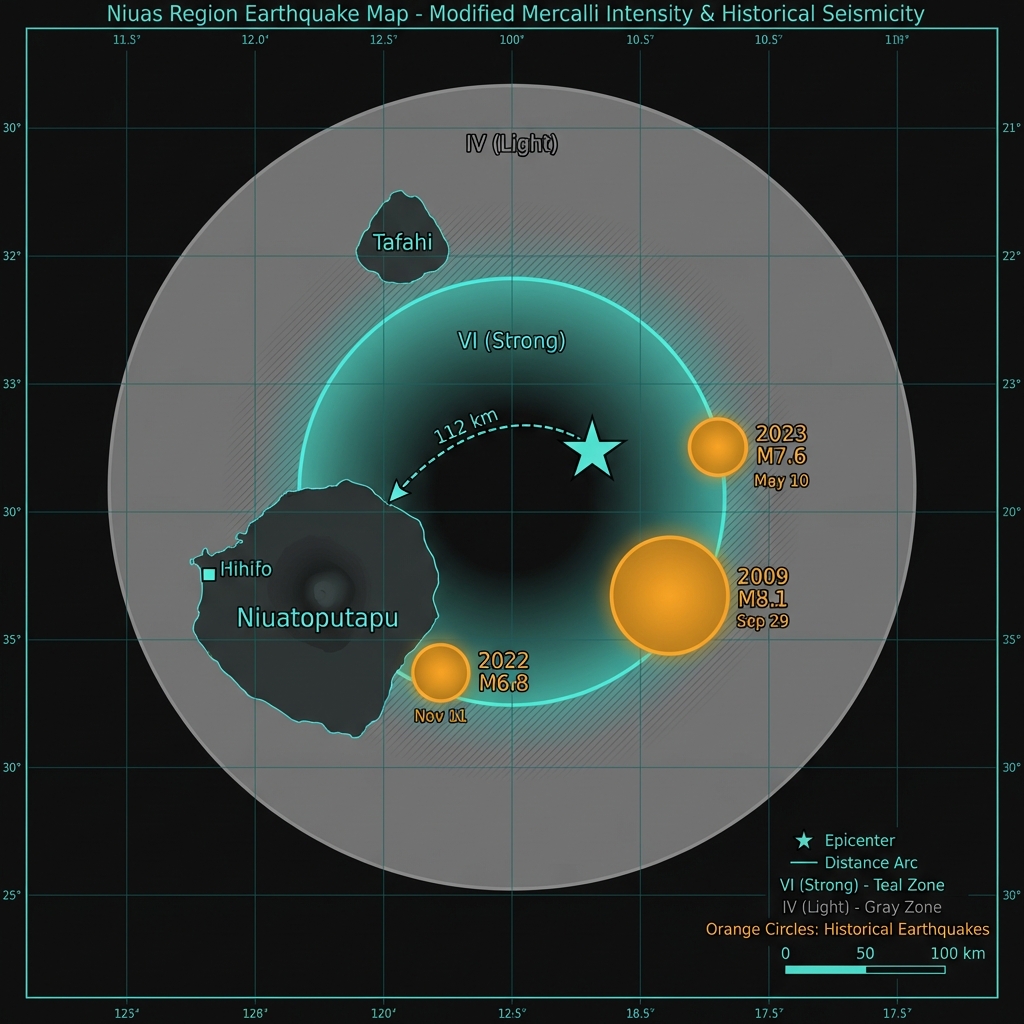
The combination of magnitude 5.8 and shallow depth creates a specific hazard signature. Ground motion can reach intensity VI (Strong) on the Modified Mercalli scale at the epicenter—sufficient to crack plaster, displace unsecured objects, and alarm populations. Because the energy releases so close to the surface, it attenuates quickly with distance, likely limiting serious shaking to the northernmost Niuas islands while sparing Tongatapu to the south.
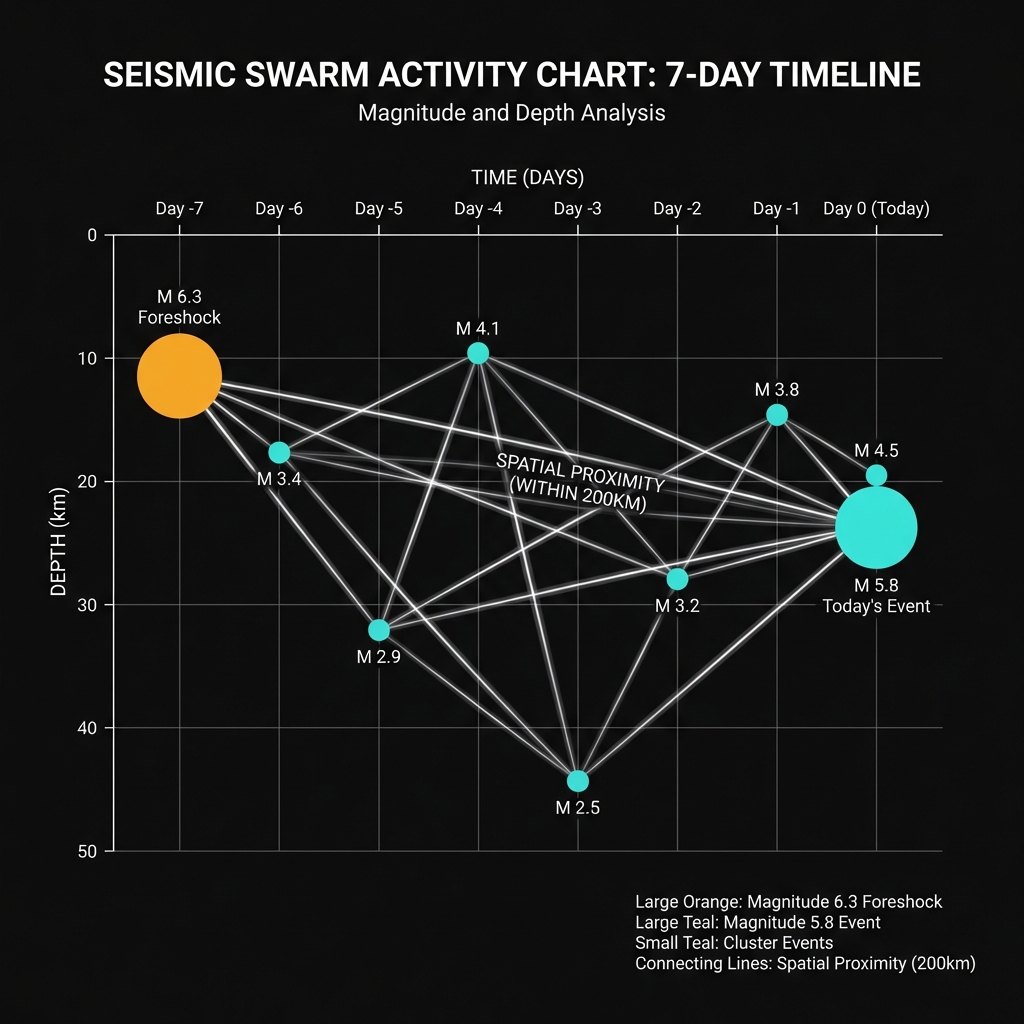
This event is not isolated. It arrives seven days after a magnitude 6.3 shock struck at the same 10-kilometer depth near the same coordinates, part of a cluster of nine seismic events recorded within 200 kilometers over the past week. Seismologists view this as an elevated swarm, possibly reflecting stress redistribution following the 2023 magnitude 7.6 event, or the background chatter of a margin that produced magnitude 6.7 earthquakes in both 1996 and 2017 within 25 kilometers of today’s epicenter. While a single magnitude 5.8 event rarely triggers tsunamis, its occurrence within this active sequence suggests the crust is adjusting to significant tectonic strain, increasing the probability of felt aftershocks in coming days.
Safety
For residents of Niuatoputapu and surrounding islands, immediate action should focus on structural assessment rather than evacuation. Inspect concrete water tanks and catchment systems for fresh cracks—these are critical infrastructure on these remote islands—and ensure gas cylinders remain secured. Check coastal bluffs and steep terrain for signs of incipient landslides, as shallow seismic waves can destabilize saturated soils. Given the recent swarm activity, treat any strong aftershock as a potential trigger for further ground failure: identify robust tables for Drop, Cover, and Hold On drills, sleep away from heavy furniture, and maintain 72 hours of emergency supplies including water purification tablets, as relief vessels may be delayed.
Closing
As the Pacific Plate continues its relentless descent into the Tonga Trench, GeoShake monitoring networks will track whether today’s shallow rupture alters stress along neighboring fault segments. The coming weeks will reveal if this magnitude 5.8 event represents the peak of the current seismic cluster, or merely another increment in the slow accumulation of strain that inevitably releases in these waters. For now, the ground has paused—but in this part of the world, stillness is always temporary.
Track this event live on the map!
Download GeoShake and get instant earthquake alerts.
Download GeoShake