Nearly four times deeper than the base of Earth’s crust, a magnitude 4.5 earthquake ruptured 538 kilometers beneath the South Pacific on March 25, sending seismic waves through the mantle transition zone—a realm where extreme pressure transforms minerals and generates mysterious, powerful quakes far removed from surface destruction. According to the USGS Earthquake Hazards Program, the tremor struck south of the Fiji Islands at 8:05 PM UTC, marking the third deep-focus event in the same region this week and offering seismologists a rare window into the brutal mechanics of a subducting tectonic slab.
Why Is This Region So Seismically Active?
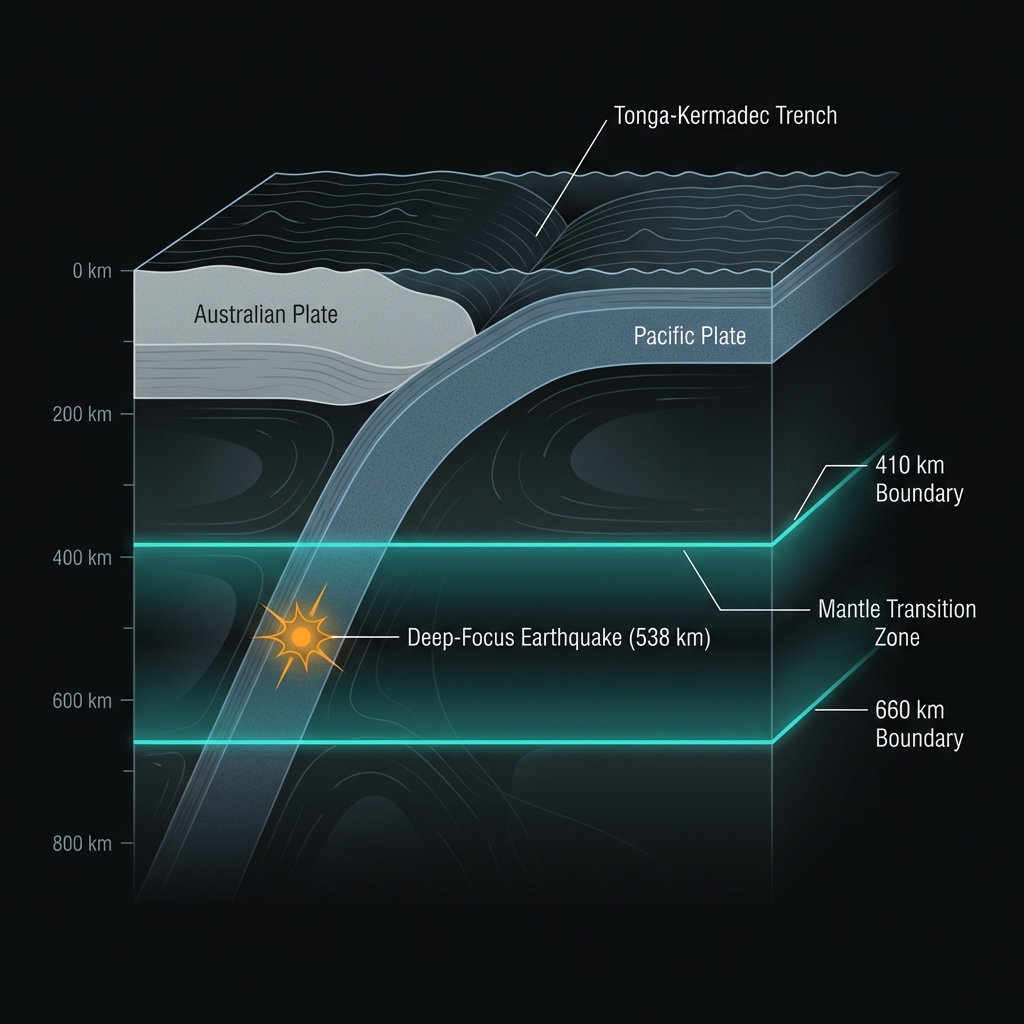
The violent ballet begins at the Tonga-Kermadec Trench, where the ancient Pacific Plate plunges beneath the Australian Plate in one of Earth’s fastest subduction zones. As the slab descends into the mantle, it remains cooler and more brittle than the surrounding rock for hundreds of kilometers, creating conditions where sudden fracturing can occur even under crushing pressures that would typically render rock ductile.
This particular earthquake occurred within the mantle transition zone, a boundary layer between 410 and 660 kilometers depth where olivine—the most abundant mineral in the upper mantle—undergoes dramatic phase transitions into denser crystal structures like wadsleyite and ringwoodite. Seismologists classify earthquakes deeper than 300 kilometers as deep-focus events, and this week’s cluster suggests persistent internal fracturing within the descending slab as it contorts through these mineralogical boundaries. The region has hosted ten magnitude 6-plus earthquakes since 1993, including a magnitude 6.8 event in 2022 just 131 kilometers away, though those shallower tremors posed far greater hazards to the surface world.
| Event Characteristic | March 25, 2026 | Recent Swarm (Largest) | Typical Shallow Quake |
|---|---|---|---|
| Magnitude | 4.5 | 4.8 | 4.5 |
| Depth | 538 km | 534 km | 10-20 km |
| Felt Intensity | Not felt | Not felt | Light to moderate |
| Tsunami Risk | None | None | Possible (if submarine) |
What Does This Depth Mean for People on the Surface?
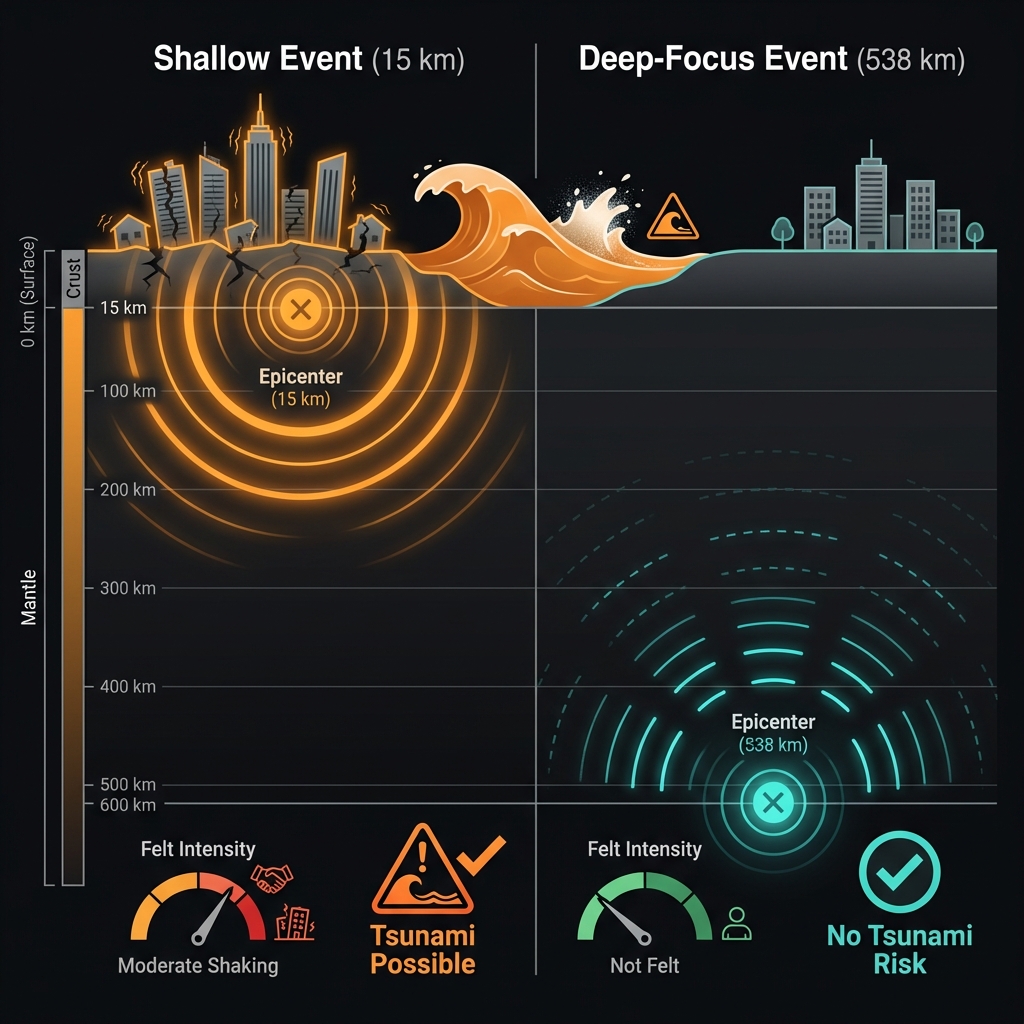
When earthquakes occur at such extreme depths, the sheer volume of rock above the rupture acts as a natural shock absorber, dissipating seismic energy before it reaches inhabited islands. While a magnitude 4.5 earthquake at shallow depth might rattle windows and disturb sleep across Fiji, this deep-focus event likely produced no perceptible shaking on the islands above, despite occurring directly beneath the archipelago.
The absence of tsunami risk further illustrates the physics at play. Tsunamis require vertical displacement of the seafloor, typically from shallow submarine earthquakes. At 538 kilometers depth—roughly the distance between London and Paris by road—the rupture occurred far too deep to disturb the ocean basin above. This contrasts sharply with the region’s history of magnitude 6-plus events, such as the 2022 magnitude 6.8 earthquake, which occurred at shallower depths capable of generating significant surface waves and potential ocean disturbances.
What Should We Watch For?
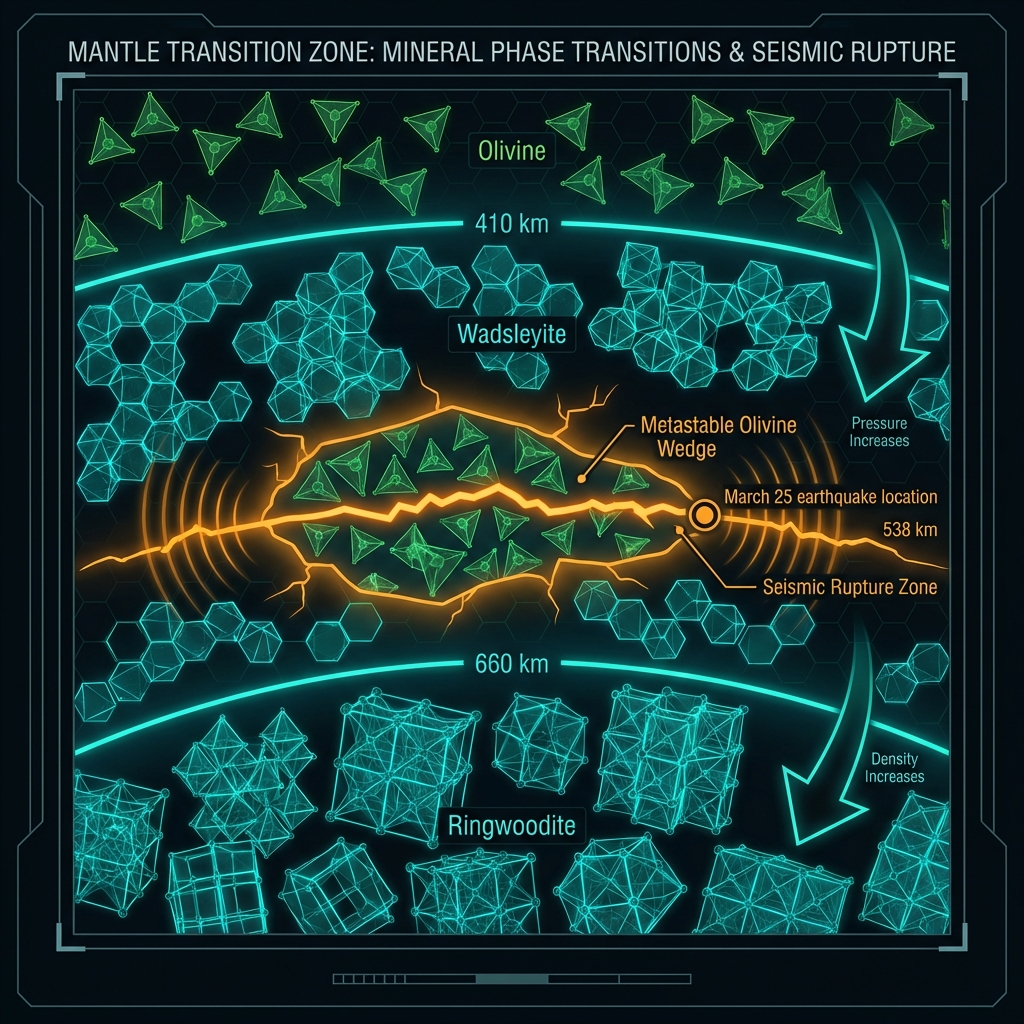
Seismologists will monitor this cluster closely, not for immediate hazard to populated areas, but for what it reveals about the fate of subducting slabs. The persistence of brittle failure at these depths challenges classical models of mantle behavior and may indicate the presence of “metastable olivine wedges”—pockets of minerals that remain unchanged under high pressure until sudden collapse triggers seismic rupture. As the Pacific Plate continues its descent toward the core-mantle boundary, GeoShake’s monitoring networks will track whether this week’s fracturing represents isolated stress release within the slab or signals a broader rearrangement of forces in the mantle transition zone.
Frequently Asked Questions
How strong was this earthquake?
The USGS recorded a magnitude of 4.5 mb, classifying it as a light earthquake on the global scale. However, because the rupture occurred 538 kilometers beneath the surface, no significant shaking was reported on the Fijian islands above, and the event was imperceptible to human observers without sensitive seismometric equipment.
Why do earthquakes happen so deep beneath Fiji?
The region sits above the Tonga-Kermadec subduction zone, where the Pacific Plate dives beneath the Australian Plate at a rate of up to 24 centimeters per year. Earthquakes occur within this descending slab as it remains cooler and more brittle than the surrounding hot mantle, allowing rock to fracture even under extreme pressure hundreds of kilometers deep—a phenomenon that continues until the slab reaches depths where heat finally equalizes and the rock becomes ductile.
Is there a tsunami risk from deep earthquakes?
No. Tsunamis require vertical displacement of the seafloor, which only happens during shallow submarine earthquakes, typically less than 50 kilometers deep. At 538 kilometers depth, this earthquake occurred far below the ocean crust and could not generate the water column displacement necessary to create a tsunami, regardless of its magnitude.
Track this event live on the map!
Download GeoShake and get instant earthquake alerts.
Download GeoShake