Ten kilometres below the cobalt surface of the Pacific, the Earth’s crust splintered. At 10:26 PM local time on March 22, a magnitude 5.9 earthquake ruptured just beneath the seafloor, 111 kilometres east-northeast of Hihifo in Tonga’s northern reaches. This was no isolated convulsion. It marked the ninth tremor to rattle this patch of ocean in seven days—a restless pulse in one of the planet’s most aggressive subduction zones, uncomfortably close to the underwater scar left by the devastating 2009 Samoa earthquake.
The Tectonic Squeeze
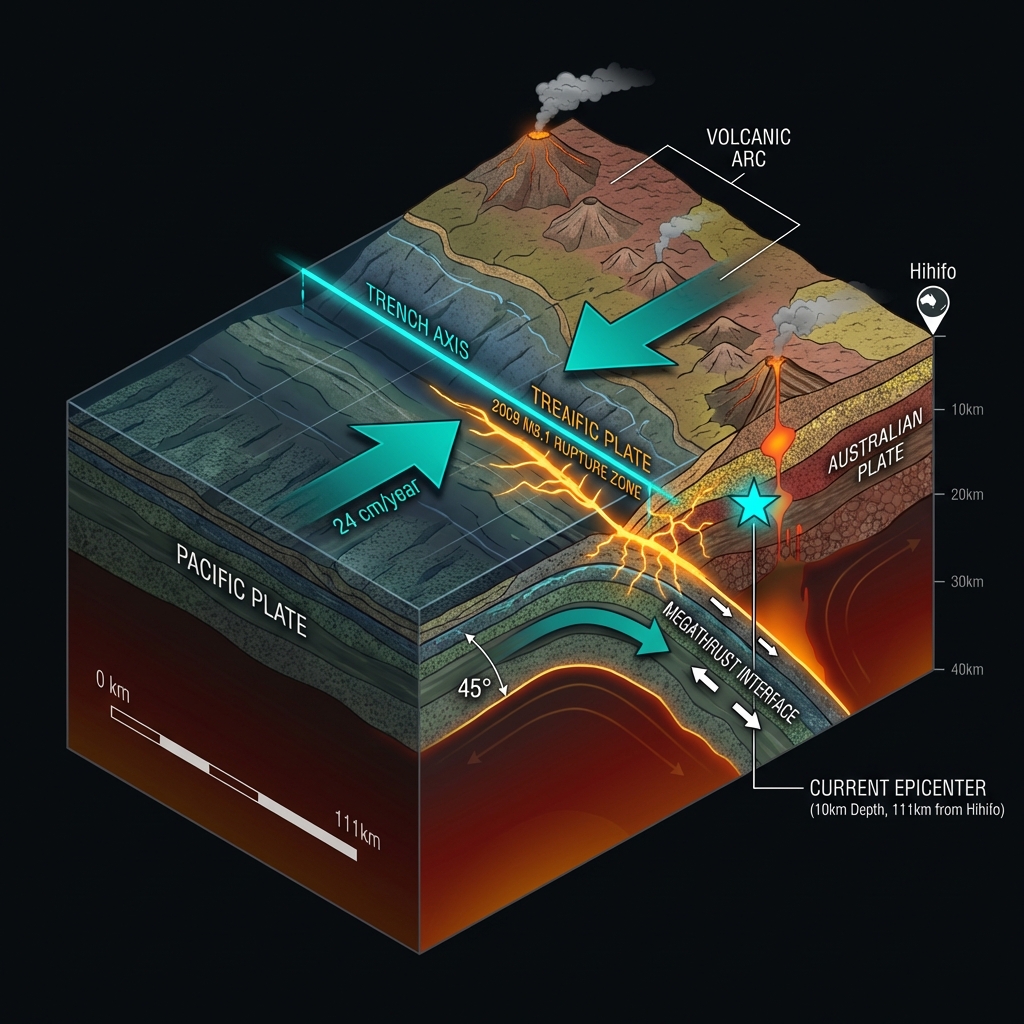
The Tonga-Kermadec Trench is where tectonics turn violent. Here, the Pacific Plate—ancient, dense oceanic crust—dives beneath the Australian Plate at a rate of roughly 24 centimetres per year, one of the fastest subduction velocities on Earth. This collision creates a crushing conveyor belt of geological stress, periodically releasing energy as the overriding plate buckles and snaps upward. Seismologists classify this region as a “subduction megathrust” zone, a term describing the interface where one plate grinds beneath another, capable of generating the world’s most powerful temblors.
This particular patch of seafloor carries a heavy history. Just 79 kilometres from Saturday’s epicentre, the magnitude 8.1 Samoa earthquake of 2009 ruptured a similar segment of the trench, triggering a tsunami that claimed nearly 200 lives across Samoa, American Samoa, and Tonga. More recently, a magnitude 7.6 quake struck 179 kilometres to the west-northwest in 2023, while clusters of magnitude 6.8 events have peppered the area in 2022 and 2017. When the crust here breaks, it does not whisper.
Why Depth Matters
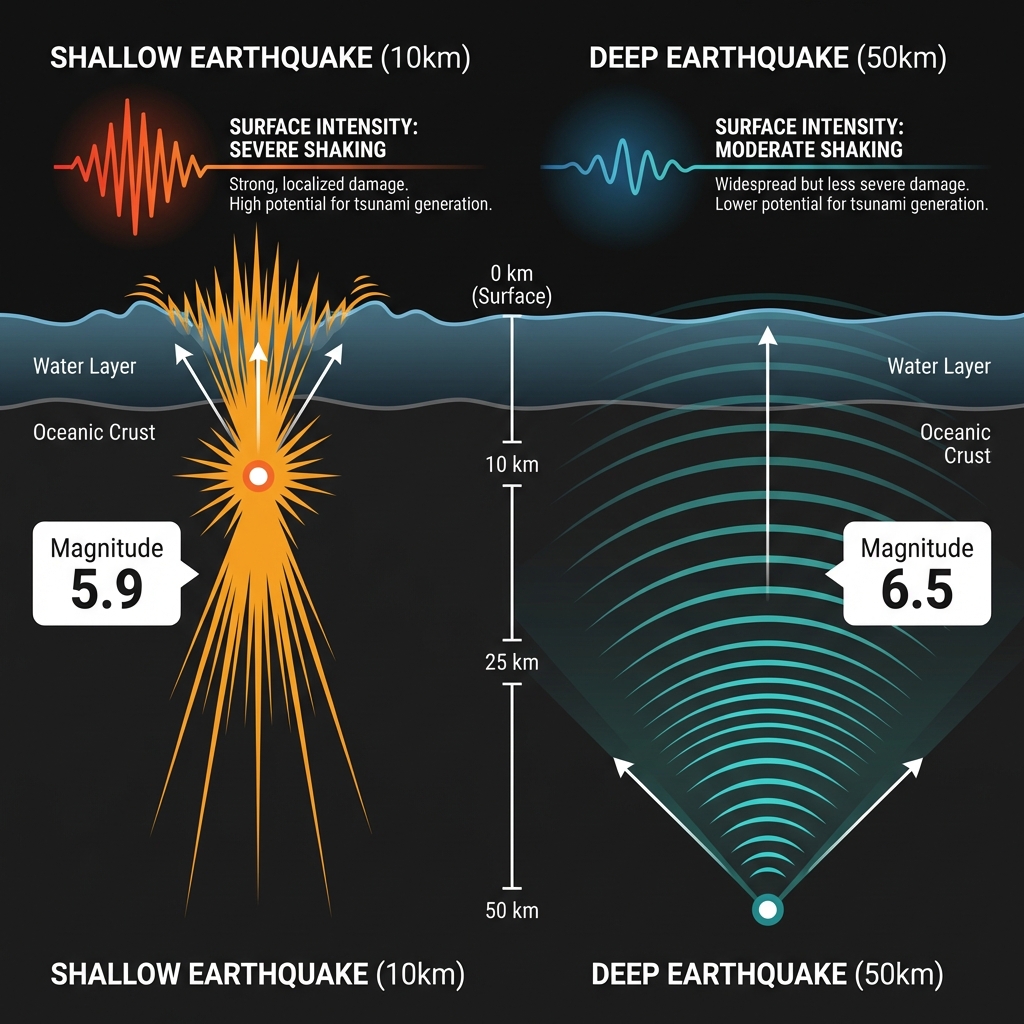
The depth—just 10 kilometres—transforms this from a routine offshore tremor into something more visceral. In seismological terms, this qualifies as “extremely shallow,” meaning the seismic waves have barely any overlying rock to absorb their energy before reaching the surface. A magnitude 5.9 at 10 kilometres depth can produce shaking intensity comparable to a magnitude 6.5 event buried at 50 kilometres, though the energy dissipates more quickly with distance. Residents on the northern Tongan islands likely experienced sharp, jarring motions rather than the rolling sway typical of deeper quakes, with perceptible shaking potentially reaching as far as 150 kilometres away—roughly the distance from London to Birmingham, or New York to Philadelphia.
This event arrives amid an unmistakable escalation. Six days earlier, a magnitude 6.3 quake struck at a similarly shallow 10 kilometres just 33 kilometres northeast of today’s epicentre. Together, these nine events in a week suggest the subduction interface is undergoing a phase of readjustment, releasing accumulated strain in fits and starts. While swarms are common in volcanic arcs, the proximity to the 2009 rupture zone—where stress redistribution continues nearly two decades later—demands particular scrutiny.
Immediate Precautions
For residents of Niuatoputapu and the Niuas island group, this shallow sequence carries specific risks beyond the immediate tremor. Unlike deeper quakes that shake and pass, shallow crustal events in swarms can generate sudden, unpredictable jolts for days or weeks. Authorities advise securing top-heavy furniture and water tanks immediately, as these shallow shocks produce high-frequency vibrations capable of toppling unsecured objects even at moderate magnitudes. Given the potential for this swarm to either trigger a larger mainshock or simply continue its irregular drumbeat, residents should maintain full emergency kits and establish family communication plans now, while phone lines are clear. Boaters should remain aware that shallow offshore quakes, while not generating tsunamis at this magnitude, can occasionally dislodge underwater sediments or trigger localised seiches in harbours.
What to Watch For
GeoShake monitoring systems will continue tracking this swarm for changes in frequency, depth, or magnitude—particularly watching for any migration of hypocentres toward the trench axis, which could signal a larger rupture in preparation. The Tonga-Kermadec zone does not sleep; it merely gathers its breath between events. As this latest shallow tremor reminds us, the boundary between the Pacific and Australian plates remains a work in progress, sculpting the ocean floor one fracture at a time.
Track this event live on the map!
Download GeoShake and get instant earthquake alerts.
Download GeoShake