The Deep Rupture
In the crushing darkness five hundred and one kilometers beneath the Pacific Ocean, where the seabed has long since given way to the immense pressures of Earth’s mantle, a sudden rupture sent seismic waves racing outward through the planet’s interior. The magnitude 5.2 tremor that struck on March 22, 2026, did not disturb the surface waters 219 kilometers east of Levuka, Fiji—it was born too deep for that—but it landed just 69 kilometers from the epicenter of the 2018 M8.2 earthquake, one of the deepest major temblors ever instrumentally recorded. At this depth, the event belongs to a rare and scientifically precious class of deep-focus earthquakes that originate in the very fabric of a subducting tectonic plate, offering seismologists a window into forces usually hidden from view.
The Subduction Zone’s Legacy
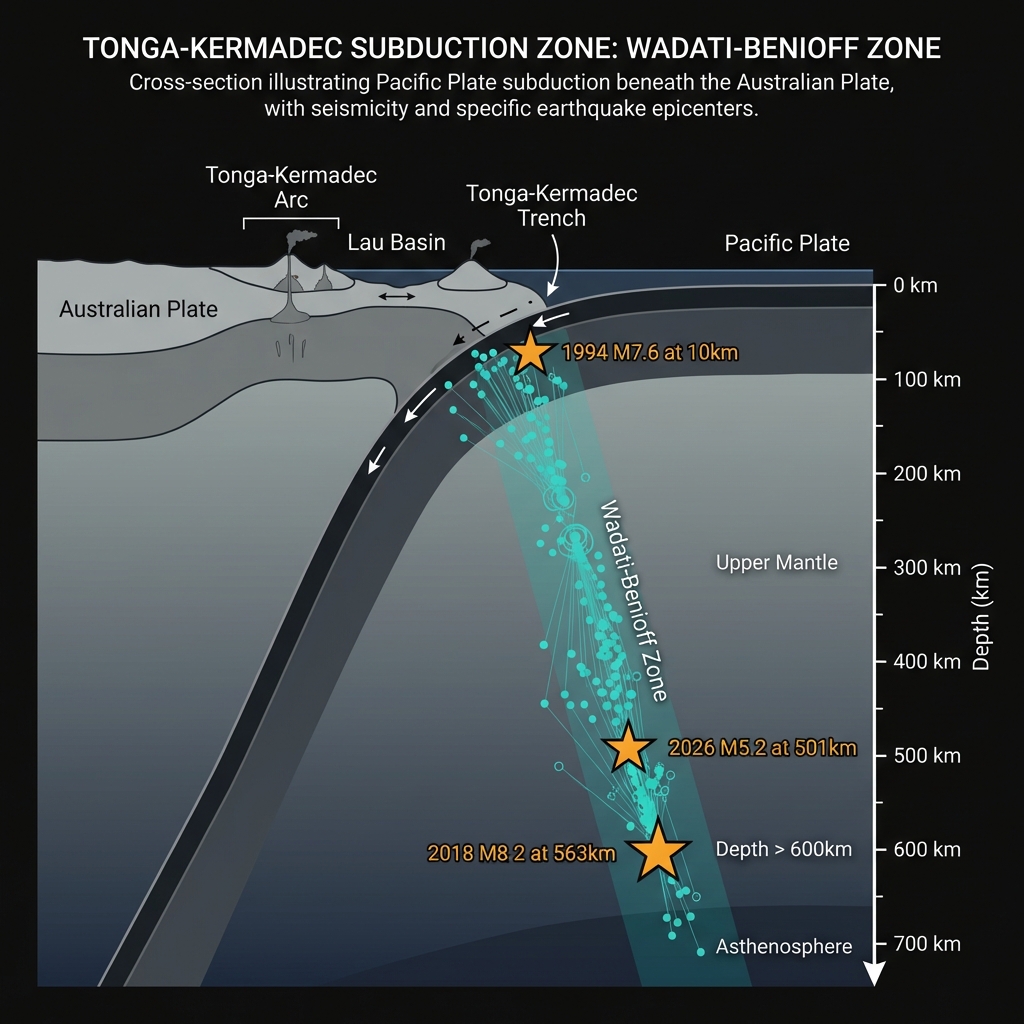
This particular corner of the Tonga-Kermadec subduction zone represents one of Earth’s most active convergent boundaries, a region where the Pacific Plate dives beneath the Australian Plate at rates exceeding 24 centimeters per year. The zone has hosted a remarkable concentration of deep seismicity over the past four decades, establishing itself as a natural laboratory for extreme-depth earthquakes. In August 2018, the magnitude 8.2 event ruptured approximately 563 kilometers down—among the deepest major earthquakes ever recorded—releasing energy that, despite the depth, generated a small tsunami and caused perceptible shaking across the region.
Historical records reveal a persistent pattern of powerful deep events clustering in these waters. A M7.6 earthquake struck in 1994 just 44 kilometers from Saturday’s epicenter, followed by M7.2 and M7.1 tremors in 1998 and 2004 respectively. More recent significant activity includes a M6.5 event in 2023 and multiple M6.7 to M6.9 earthquakes throughout the 2000s. Seismologists classify earthquakes deeper than 300 kilometers as “deep-focus” events, distinct from shallow crustal quakes that typically cause surface destruction. At 501 kilometers, this tremor occurred well within the subducting slab’s interior, where the descending Pacific Plate encounters increasing pressure and temperature as it penetrates the upper mantle toward the transition zone.
Silent Energy
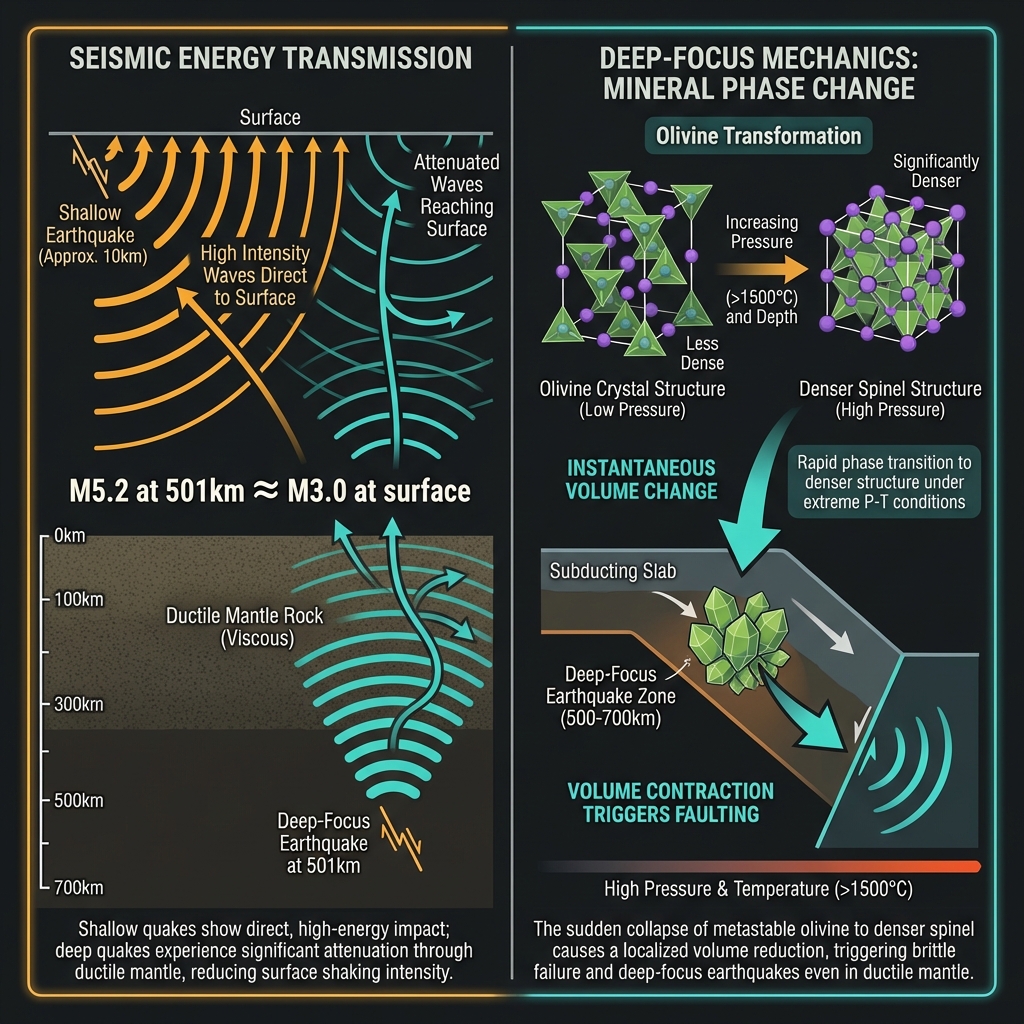
For populations in Fiji, the practical implications of such extreme depth translate to near-total isolation from the shaking. Unlike shallow earthquakes, where seismic energy races efficiently through rigid crust to the surface, deep-focus events dissipate their force through hundreds of kilometers of ductile mantle rock. An M5.2 at 501 kilometers depth typically generates surface intensities comparable to a magnitude 3.0 earthquake occurring directly beneath a city—detectable by sensitive instruments, perhaps, but rarely perceptible to humans and incapable of causing damage. This stands in stark contrast to the 2018 M8.2 megaquake, whose immense energy release—despite originating even deeper—still propagated with sufficient force to disturb the ocean column and rattle buildings hundreds of kilometers away.
The recent seismicity suggests this segment of the slab remains mechanically active; four earthquakes have ruptured in the region over the past week alone, though none approached the magnitude of the 2018 event or the 1994 M7.6 shock. These deep ruptures occur along the Wadati-Benioff zone—the inclined plane of seismicity that traces the subducting plate’s descent—and they challenge conventional earthquake mechanics. At 501 kilometers, temperatures exceed 1,500 degrees Celsius, hot enough to render rock ductile under normal circumstances. Scientists believe such events require exceptional circumstances, possibly involving mineral phase changes where olivine transforms to denser spinel structures, generating instantaneous volume changes that trigger faulting under immense pressure. Unlike shallow earthquakes that reflect accumulated tectonic stress at plate boundaries, deep-focus events may signal the internal fracturing of the slab as it encounters resistance in the transition zone between the upper and lower mantle, providing crucial clues about subduction dynamics and the ultimate fate of oceanic plates.
The Unending Descent
As global monitoring networks continue to detect these ghostly signals from the deep Earth, each event adds another data point to our understanding of how plates behave in an environment we can never directly observe. While this M5.2 tremor posed no threat to coastal communities, its proximity to the 2018 megaquake reminds us that the Pacific Plate continues its relentless descent into the mantle’s depths, carrying with it the potential for future surprises. In the quiet theater of the deep Earth, five hundred kilometers beneath our feet, the show goes on—unseen, unfelt, but never unnoticed by those listening to the planet’s most secretive tremors.
Track this event live on the map!
Download GeoShake and get instant earthquake alerts.
Download GeoShake