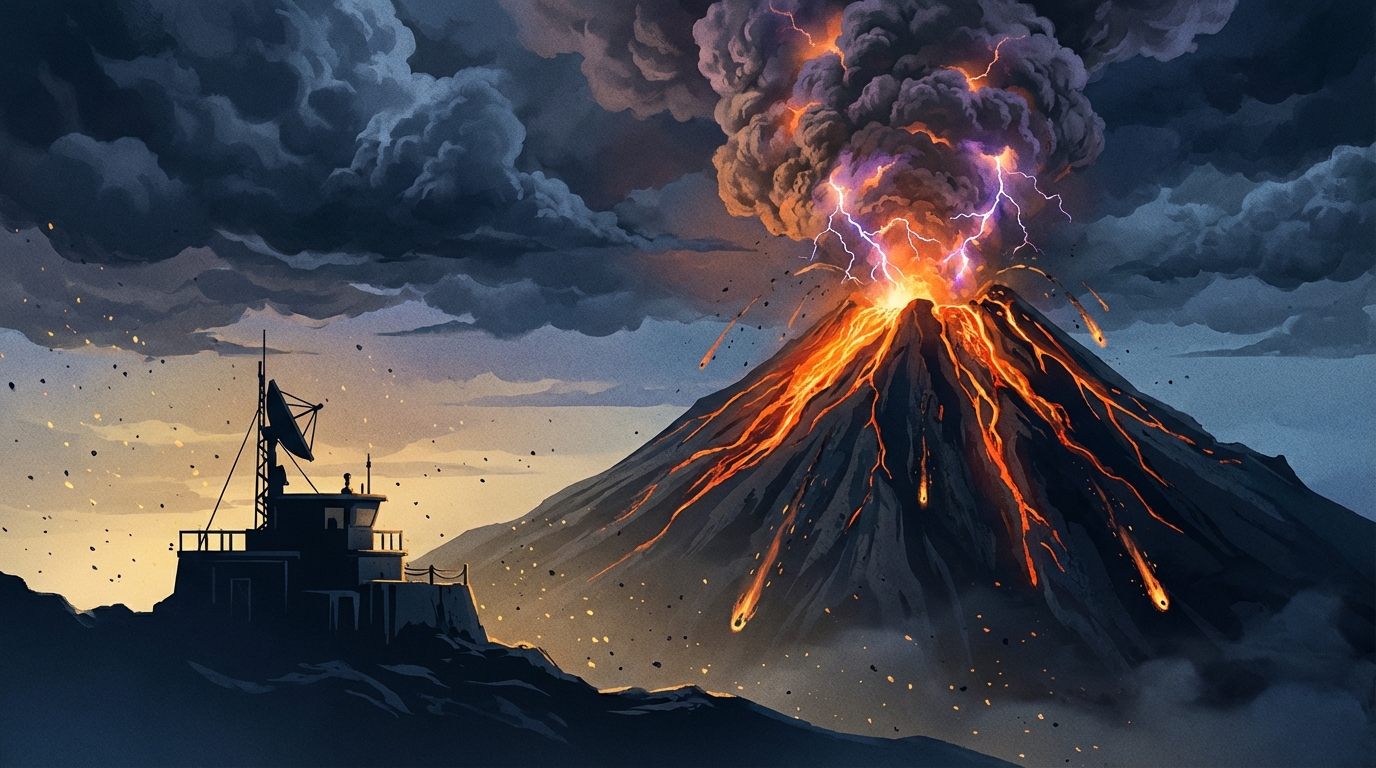
Global volcanic monitoring networks detected 40 discrete eruptive events across 22 active volcanic systems during the past 24 hours, according to the Smithsonian Global Volcanism Program. Notable activity includes explosive eruptions at Indonesia’s Semeru, persistent ash emissions from Mexico’s Popocatépetl, and elevated unrest at Guatemala’s Santiaguito, which currently maintains an Orange alert status. The Pacific Ring of Fire dominates today’s seismic landscape, with significant contributions from the Philippines, Indonesia, and the Andean Volcanic Belt requiring close observation by regional monitoring agencies.
Which Volcanoes Erupted Today?
Semeru (East Java, Indonesia) generated explosive eruptions detected by satellite monitoring systems early on March 26, 2026. This stratovolcano, which stands at 3,676 meters elevation, produced ash emissions characterized by moderate eruptive intensity, though specific ash column heights were not quantified in the initial 24-hour reporting period. The PVMBG (Indonesian Center for Volcanology and Geological Hazard Mitigation) continues to monitor seismic tremor patterns associated with the ongoing effusive-explosive activity typical of this persistently active volcanic system.
Mayon (Luzon, Philippines) exhibited continued eruptive behavior as reported by PHIVOLCS, maintaining its status as one of Southeast Asia’s most active volcanic hazards. The symmetrical stratovolcano produced lava dome growth and intermittent ash emissions, representing a continuation of the elevated unrest that characterizes its current eruptive episode. Technical parameters including precise ash altitude measurements were not specified in the daily summary data, though ground observers noted visible steam and ash plumes dispersing toward prevailing wind patterns.
Santiaguito (Guatemala) maintains an Orange alert level following explosive activity recorded late on March 26, 2026, according to INSIVUMEH monitoring networks. This lava dome complex, situated on the slopes of Santa María volcano, produced ash emissions and pyroclastic flow potential that triggered the elevated aviation and civil protection warnings. The Orange designation indicates heightened unrest with increased likelihood of hazardous eruption, requiring immediate preparedness protocols for nearby communities and aviation corridors.
Sangay (Ecuador) contributed to Andean volcanic activity with remote explosive eruptions detected by satellite thermal anomalies and infrasound sensors. This 5,230-meter stratovolcano, located within Sangay National Park, generated ash plumes that drifted toward the Amazon basin, though specific emission altitudes remained unreported in the daily data summary. The Instituto Geofísico continues automated monitoring of this isolated but frequently active volcanic system.
Popocatépetl (State of Mexico, Mexico) sustained its pattern of persistent volcanic activity with ash emissions recorded by CENAPRED monitoring stations. Located just 70 kilometers from Mexico City, this 5,426-meter stratovolcano poses significant aviation and population hazards, requiring continuous surveillance of its crater lake and gas emission rates. The current eruptive episode demonstrates the typical phreatomagmatic activity that characterizes Mexico’s most dangerous active volcano.
How Dangerous Are the Ash Emissions?
Volcanic ash clouds from today’s eruptions present multifaceted hazards to aviation infrastructure, respiratory health, and regional agriculture, according to data compiled by the Smithsonian Global Volcanism Program. While specific ash column heights were not provided for Semeru, Mayon, Sangay, or Popocatépetl in the 24-hour summary, the presence of airborne silicate particles necessitates Volcanic Ash Advisory Center (VAAC) monitoring for flight path adjustments. Santiaguito’s Orange alert status specifically triggers enhanced aviation warnings, as this volcano frequently produces ash plumes reaching flight levels between 25,000 and 35,000 feet where commercial air traffic operates.
The chemical composition of volcanic glass and crystalline silica within these ash clouds can cause catastrophic engine failure in aircraft, abrasive damage to windshields, and contamination of ventilation systems. Ground-based communities near Mayon and Popocatépetl face additional hazards from ashfall accumulation on rooftops, water supply contamination, and respiratory irritation, particularly for populations with pre-existing pulmonary conditions. Agricultural sectors downwind from Sangay and Semeru should anticipate potential crop damage and pasture contamination depending on wind trajectory and eruption intensity variations.
What Should Aviation Know?
Pilots and flight operations centers should exercise caution regarding volcanic ash hazards in the airspace surrounding Guatemala, Ecuador, Mexico, Indonesia, and the Philippines throughout the next 24-48 hours. While specific Volcanic Ash Advisory (VAA) coordinates were not detailed in the March 27 summary report, standard protocols require aircraft to maintain minimum distances of 20-50 nautical miles from identified ash clouds depending on concentration levels. The lack of specified ash height data for most of today’s events emphasizes the importance of continuous satellite monitoring and pilot reports (PIREPs) to identify ash cloud vertical extent and horizontal dispersion patterns.
Santiaguito’s active Orange alert requires particular attention for routes traversing Central American airspace, as this volcano has historically produced sudden explosive eruptions with minimal precursory seismicity. Trans-Pacific flights operating between North America and Southeast Asia should monitor Semeru and Mayon activity, as ash clouds from these equatorial volcanoes can disrupt major jet stream routes. Aviation meteorologists recommend utilizing Multi-Functional Transport Satellite (MTSAT) and GOES-East/West imagery to track ash dispersion in real-time where ground-based radar coverage remains limited.
Current Volcanic Activity Summary Table
| Volcano | Location | Event Type | Alert Level |
|---|---|---|---|
| Santiaguito | Guatemala | Explosive Eruption | Orange |
| Semeru | Indonesia | Ash Emission | Not Specified |
| Mayon | Philippines | Lava Dome Activity | Not Specified |
| Sangay | Ecuador | Explosive Eruption | Not Specified |
| Popocatépetl | Mexico | Ash Emission | Not Specified |
| Fuego | Guatemala | Strombolian Activity | Not Specified |
| Kanlaon | Philippines | Unrest | Not Specified |
| Sabancaya | Peru | Ash Emission | Not Specified |
| Ibu | Indonesia | Eruption | Not Specified |
| Taal | Philippines | Unrest | Not Specified |
| Lewotolok | Indonesia | Eruption | Not Specified |
| Marapi | Indonesia | Eruption | Not Specified |
| Atka Volcanic Complex | Alaska, USA | Unrest | Not Specified |
| Dukono | Indonesia | Continuous Eruption | Not Specified |
| Aira (Sakurajima) | Japan | Explosive Eruption | Not Specified |
| Piton de la Fournaise | Réunion | Eruption | Not Specified |
| Kilauea | Hawaii, USA | Effusive Activity | Not Specified |
| Reventador | Ecuador | Explosive Eruption | Not Specified |
| Lewotobi | Indonesia | Eruption | Not Specified |
| Merapi | Indonesia | Dome Growth | Not Specified |
| Great Sitkin | Alaska, USA | Eruption | Not Specified |
Frequently Asked Questions
How dangerous is volcanic ash for aircraft engines?
Volcanic ash contains microscopic silicate glass particles that melt when ingested by jet turbine engines operating at high temperatures, causing the molten material to adhere to turbine blades and block airflow. This process can induce complete engine flameout and stall within minutes of exposure, even when ash clouds are invisible to radar or naked eye observation. Flight crews encountering ash may notice engine surging, smoke in the cabin, and acrid odors, requiring immediate throttle reduction and exit from the contaminated airspace to prevent catastrophic failure.
What does an Orange volcano alert level signify?
An Orange alert indicates that a volcano is exhibiting heightened or escalating unrest with increased potential for eruption, or that an eruption is already underway with limited hazards to ground-based communities. This level triggers specific preparedness protocols including restricted access to summit areas, enhanced monitoring frequency, and preliminary evacuation planning for high-risk zones. Aviation authorities use Orange alerts to initiate Volcanic Ash Advisory Center coordination and recommend flight path diversions around the affected volcanic system.
How quickly can volcanic activity escalate from minor to hazardous?
Volcanic systems can transition from minor steam emissions to explosive eruptions within hours, days, or weeks depending on magma supply rates, gas content, and conduit geometry. Monitoring networks detect precursory signals including increased seismic tremor, ground deformation measured by GPS, and rising sulfur dioxide emissions, typically providing warning periods ranging from days to months before major events. However, some volcanoes like Santiaguito and Sangay exhibit rapid transitions with minimal precursory activity, necessitating continuous real-time surveillance regardless of apparent dormancy periods.
Track this event live on the map!
Download GeoShake and get instant earthquake alerts.
Download GeoShake